Friday, February 17, 2012

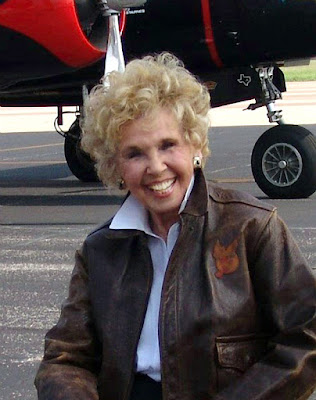
WASP MARY REINBERG BURCHARD, 44-W-6 Jan. 28, 2012


Mary Reineberg Burchard
February 29, 1916 -  January 28, 2012

Mary Reineberg Burchard was a test pilot with the Women AirForce Service Pilots (WASP) of WWII, a Congressional Gold Medal recipient.  a proud veteran, doctor, and beloved mother and friend.   Even within weeks of her passing, whenever Mary heard a plane she’d scan the sky, shake her fist and say, “You lucky stiff!”  The lure of flying never left her.  The call to take her last flight came on January 28, 2012 surrounded by her faithful crew of children and loving caregivers at Aegis Living of Laguna Niguel California.  She was 95.

Mary was born in 1916 in York, Pennsylvania.  She was the oldest child of a well-known York shoe store family, Jacob and Salome Reineberg. 

Inspired by Amelia Earhart’s flying feats, 12 year old Mary Reineberg stood up in her class at St. Mary’s Elementary School and announced, “I’m going to be an aviatrix!” Mary always laughed at how audacious it must have sounded for this little girl to have such grand ambitions.

Upon graduation from high school, Mary was among the first women to study at Temple University’s School of Surgical Podiatry in Philadelphia.  She graduated at 21 as a surgeon-podiatrist, being given the highest honor ever awarded a woman in clinical proficiency.  Mary returned to York to open her practice.

While she worked hard as a young doctor, the dream of flying never went away.  It took 11 years from her grade school pronouncement to do it.  During the early part of World War II, Mary got her pilot’s license through the national defense program where she and 9 male pilots made up the Civil Air Patrol – York Squadron 301.

As the war raged on, Mary wanted to do more and knew her flying skills were needed.  Out of 25,000 applicants, Mary was one of 1,830 accepted into the visionary and grueling Women AirForce Service Pilots training.  With the WASP she learned to fly the “military way” at Avenger Field in Sweetwater Texas. Only 1,074 women earned their wings and Mary Reineberg was one of them.  Based in Marana, Arizona, Mary was a test pilot on the AT-6, an advanced trainer plane that was the essential part of training men for combat.  Above the Arizona desert she put these planes through hammerhead stalls, barrel rolls, loops and other gut-wrenching maneuvers to diagnose problems, make sure bolts and oil lines stayed on, and landing gears locked in place.  Mary loved every minute of it.

Her WASP dream came to an end with the sudden order to deactivate all the women military pilots to make jobs for the men who were not needed in great numbers in combat.  Though shattered by this, Mary looked for how else she could help her country and joined the American Red Cross.  Mary was sent to Naples and southern Italy where she spent 18 months as director of social activities for American troops waiting to go home. This was a perfect fit for Mary who was gregarious, enterprising, fun-loving and a natural organizer.  She loved Italy, loved the work, and proud she could help until the war ended.

On the troop ship coming home Mary met her future husband, Jack McDargh.  They married, moved to Denver Colorado and had three children, twins Dr. John McDargh and Eileen McDargh Elvins, and Susan Mullins.  Over the years, the family moved several times, with Fort Lauderdale, Florida being the place Mary called home for 40 years.

Though those bigger-than-life adventures gave way to joys and difficulties of family life, her children say Mary taught them all those lessons and values which defined her early years.

“Our mom gave us her love of adventure and travel. If she couldn’t join us, she was our pocket companion wherever we went in the world.  She modeled for us courage and calm in the face of hurricanes, accidents, and illness.  Her resiliency and fierce independence sustained her through life’s changing times.  Mom passed along a deep belief in service to our country, to God, community and family.  She delighted in the beauty of a flower, a sunset, a poem, a joke, and a good meal.  Mom gave hugs with real meaning.  She believed in us even when we weren’t able to. With everyone she’d want to know, “So, what are you up to?” and she really wanted to know.  Mom took every opportunity until her last breath to let us know she loved us.

All who met her will remember her broad smile, her twinkling blue eyes, and how her laughter burst up from deep inside. Mom worked hard and lived frugally and yet never failed to ask, “Do you need money?  Can I help?”  And there was always music and singing. With Mom at the piano or A cappella we sang all those great songs from the two World Wars. Music and singing sustained her and us in the last difficult years of her life.  She would still mouth the words as we sang around her bed when if she didn’t have the energy to do the tune.”

Mary was given many nicknames by those who loved her—Doc, Mamacita, Mama, Mamoo, Mambo, Nana, Mrs. G, The Duchess, and simply “Mom”.  She loved that.

Mary is survived by her sister, Sr. Clare Reineberg ASC (Columbia, PA), her children Dr. John McDargh (Boston), Eileen McDargh Elvins (Dana Point, CA), Susan Mullins (Los Angeles), loving son-in-laws, 5 grandchildren and 4 great-grandchildren.

A memorial service will be held at 1 p.m. on May 4th at St. Mary’s Church in York, PA. In honor of Mary, donations could be given to The National WASP-WWII Museum (P.O. Box 456, Sweetwater, TX 79556 or to help today’s severely injured soldiers “The Wounded Warrior Project” (4899 Belfort Rd. Suite 300, Jacksonville, FL  32256)


v/r posted -- written by Mary's daughter, Susan Mullins.

Wednesday, January 11, 2012

GERI ELDER LAMPERE NYMAN, 43-W-1 December 30, 2011

Geraldine "Geri" Nyman
(Official article reposted from the Arizona Republic's online obituary at Legacy.com)   
Geraldine "Geri" Nymanof Casa Grande and Phoenix, Arizona, died on December 30, 2011.   She was 91. 

Geri was in the first class of 25 Women Airforce Service Pilots ("WASP") - the women who flew military aircraft in World War II.   One of the proudest moments in Geri's life was when she and Van, her husband of 69 years, attended the March, 2010 ceremony in Washington D.C. at which the WASP received the Congressional Gold Medal for their service and sacrifices.

But the WASP didn't make Geri; she was plucky from the start. 

Geri was born in Emmett, Idaho in 1920, just when the Pacific Northwest was getting its ten year head start on the Great Depression. Geri spent some of her early years with her paternal grandmother, Mattie, a beaver trapper who lived on a remote Wyoming ranch. One of Geri's favorite pictures is astride her enormous horse, accompanied by her dog in front of the nearest one-room school house.

Most of Geri's youth was spent accompanying her parents - an itinerant barber and a fruit packer - as they traveled from town to town and camp to camp in their Model A roadster in search of entrepreneurial opportunities. The life apparently suited her; by the time she graduated from high school, Geri had skipped two grades, led her high school debate team, and learned to sew, weave, crochet and knit every fiber she could find. 

After two years of college, and a few months of small jobs, Geri decided that she wanted to fly. So she agreed to do the bookkeeping at the local air field in exchange for flying lessons. She quickly became a flight instructor, moved on to taking hunters into the wilderness, and then graduated to piloting multi-engine planes for smoke jumpers. By the time the WASP were formed in 1942, Geri was a 23 year old with over 2000 hours flying multi-engine aircraft.
 It was just the experience the WASP were looking for. 

After the war Geri helped her new husband, Van (whom she had met on a troop train) earn his flying license, and they moved to Alaska, where they owned and operated a bush pilot service. After four years - which produced three sons (Paul, Ken and Bruce) and an airplane- shaped hole in the ice - they moved to the mining town of Wallace, Idaho, where Geri owned and managed a dime store while Van completed his engineering degree.

The family lived in the basement of the dime store while Van and Geri saved for a three month trip to Europe, which they memorialized with Geri's pen and Van's Leica camera. 50 years later, the three sons can still recall almost every day of that trip.

While in Idaho, Geri was the only woman on the Wallace City Council, attended the 1964 National Republican Convention, helped Barry Goldwater win one of the least conservative counties in Idaho, was PTA parent of the year, and was active in Eastern Star, PEO, the League of Women Voters, and the Episcopal Church. And in 1970, she was in charge of the Census for Eastern Washington and North Idaho. 

Meanwhile, she sewed her sons' shirts, knitted their sweaters, darned their socks and supervised as they washed and ironed their own clothes. 

Geri and Van moved to Casa Grande in 1971. In 1976, Geri helped manage Barry Goldwater's Senatorial campaign in Pinal County - which he had never won. He won the county by one vote. 
One of Geri's award winning baskets, made from pine needles.

In the 1980's and 1990's, she won several first prizes for her pine needle baskets at the Arizona State Fair.

Geri was a dynamo, and she will be remembered. She is survived by her husband and best friend, Van (93), by her three sons, three terrific daughters-in-law (Kathy, Kristine and Pam), eight grandchildren, and six great-grandchildren. 


Donations can be made (in memory of Geri) to the Beatitudes Campus of Care or to Hospice of the Valley .
____________

The following respectfully written by Nancy Parrish, Director Wings Across America, with quotes from Geri Nyman's Wings Across America Digital Video Interview, November, 2001.

Geri Nyman was a very special and memorable lady.  She was one of only twenty-three  women who graduated as a member of the very first class of women Airforce Service Pilots.  Having accumulated over 2,000 hours of flying time, she was recruited by Jacqueline Cochran to be in the second group of American women pilots to travel to England to fly with the ATA and( Air Transport Auxiliary of the Royal Air Force).  After she agreed, she received a phone call from Nancy Love, asking her to join the civilian women group being formed to ferry aircraft in the US.  Geri turned her down-- because she thought she was on her way to England.

WASP Geri Nyman, November, 2001
"Two weeks before I was to go to England, Jackie (Cochran) called me and said, "Get up to my NY apartment-- I’ve got news for you!"  I got up there and she said,  “I guess we’ve harassed them enough-- because I’ve just had authorization to start a Women’s Flying Training  Program in Houston.  But I have to tell you, you not only need lots of hours, you need lots of stamina.”  Then she showed me a letter and said,  “I’m not supposed to have this.” It was from the Air Force to the commanding officer that would be in charge of these first 25 (women pilots)-- and it said, “We have been told we must give these women an opportunity to fly. We know they will never be able to fly military aircraft.  Get rid of them as soon as possible.”   I guess we thought we could beat the odds."    
   
Indeed they did, and more!  With fearless determination and a deep sense of patriotism, Geri Nyman and her fellow classmates became the FIRST women pilots in history to complete the Army Air Forces "Women's Flying Training Program,"  graduating and earning their silver WASP wings on April 24, 1943. 

Geri and Van Nyman -- Medal Ceremony, March 10, 2010
As a proud member of that first trailblazing group, Geri  leaves behind an even more important  inspirational legacy of compassion, courage, humor, grit, and boundless energy. 

It was an honor to know her, and our time with Geri in her Arizona home was priceless.  When asked, "Other than your family, what is the one thing you are most proud of?"  Geri's answer?  "The things we did for other people."  

God bless her wonderful family and the countless souls who have been touched by Geri's story and challenged to fly higher and continue to do just a little more for other people.  


All photos -- Wings Across America
_______________


"Bean Salads & Bamboo Bombers" By Geri Nyman
 April 5, 2011 


http://www.beatitudescampus.org/about/blog/bean-salads-and-bamboo-bombers/

Friday, December 9, 2011

WASP Dorothy Ebersbach -- a legacy of caring

World War II aviator and nurse Dorothy Ebersbach gives CWRU $2 million for flight nurse program

Published: Thursday, December 08, 2011, 6:26 AM     Updated: Thursday, December 08, 2011, 9:07 AM
Dorothy Ebersbach

Dorothy Ebersbach served in the Women Airforce Service Pilots (WASP) during World War II.
CLEVELAND, Ohio -- An aviator who served in the Women Airforce Service Pilots during World War II, then spent her career as a nurse, has donated $2 million to a Case Western Reserve University program that encompasses both of her passions -- flight nursing.

The Dorothy Ebersbach Academic Center for Flight Nursing will be established at the Frances Payne Bolton School of Nursing, where Ebersbach earned a nursing degree in 1954. She died last month at 96.
The center will expand the Advanced Practice Flight Nurse Program's mission of training graduate-level nursing students to provide on-site care during emergencies and transport to medical facilities.

The program for nurse practitioners is the only one of its kind based at a U.S. nursing school, officials said. Fourteen students have graduated and eight are in the program. About 250 flight nurses have been trained through its summer camp.

The university had planned to transport Ebersbach by air from her Florida home to Cleveland to announce her gift, said Mary Kerr, dean of the nursing school.

Ebersbach, a longtime donor to the nursing school, enjoyed discussing her role in aviation and the school's flight nursing program, Kerr said.
"Separate elements of her life have merged to continue her legacy of flight and nursing," said Christopher Manacci, clinical director of the program. "This will help perpetuate this program for decades."


Ebersbach grew up in Pomeroy, Ohio, and received a bachelor's degree in education from Ohio University in 1936, according to her obituary and an oral history she gave in July, 2010.

She worked for her father's construction company in Tampa, Fla., a job that required her to learn how to fly an airplane. She earned a commercial pilot's license at the University of Tampa. After the United States entered World War II, she applied to and was selected to be a member of the Women Airforce Service Pilots, or WASP.

According to the National Museum of the United States Air Force, more than 25,000 women applied for pilot training under the WASP program. Of these, 1,830 were accepted, 1,074 graduated and 900 were in the program when it was disbanded in December 1944 as men began returning from the war.
Ebersbach served in Texas and Arizona, doing test flights and towing targets for gunnery practice. She wanted to continue flying after the WASP program ended, but men flooded the market for pilots. So, she chose another career.

After receiving her nursing degree, she worked in public health nursing in Hillsborough County, Fla., until her retirement in 1975. She never married and lived in the house her family moved into in 1935.
WASPs were considered civilians rather than military personnel. But they were granted veteran status in 1977.

In a ceremony at the U.S. Capitol in March, 2010, the Congressional Gold Medal, the highest honor awarded by Congress to a civilian, was given to all WASPs. Ebersbach received hers at a ceremony in Tampa a month later.

v/r republished from the Plain Dealer Blog

Sunday, November 27, 2011

WASP Jean Francis McCart, 44-W-4 Nov. 25, 2011

Jean McCart took her last flight on November 25, 2011, surrounded by her family.

Jean was born in Oakland, California on March 20, 1921.

During World War II, a select group of young women pilots became pioneers, heroes, and role models...They were the Women Airforce Service Pilots, WASP, the first women in history trained to fly American military aircraft. Jean was a proud member of that elite group. She recently remarked that “being a WASP impacted my life in many ways…(it) gave me a lot of confidence in myself and provided me with wonderful, lifelong friends”.

On November 23, 1977 a Congressional Bill gave the WASP veteran status and in March, 2010, Jean and her fellow WASP were honored with the Congressional Gold Medal. This honor was very meaningful to Jean and to her family.

After her retirement from the military, she became a flight instructor, focusing on flight aerobatics. Her special maneuver was a double snaproll, and she took great delight in showing her students what she was capable of doing!

Jean was an accomplished business woman and owned the Beverly-Cross Personnel Service, a multiple office temporary personnel service in Southern California which she sold in 1989.

Jean loved to fly fish and lived part time in Montana. During the summer months, you could find her fishing in nearby rivers. Her favorite spot was the Three Dollar Bridge on the Madison and beyond.

Jean was much loved and will be truly missed by her sisters Joan Flatley of Channel Islands, Heidi Helbig of Mammoth Lakes, Elizabeth Rice Grossman of Thousand Oaks, and nephew Michael Niemeyer of Seal Beach.

At the time of her death, Jean resided in Hollywood Beach in Ventura County.

Jean had a wonderful, productive life, enjoyed many friends, and impacted the lives of countless people. A great lady. Fly with the angels Jean. You will be missed by all who had the privilege of knowing you.

Services are pending.

v/r posted  from Jean's family

Thursday, November 17, 2011

WASP Elizabeth 'Betty' Haas Pfister, 43-W-5 Nov. 17, 2011


 Elizabeth Haas Pfister passed away peacefully at her home in Aspen, Colorado on November 17, 2011.  b July 23, 1921 - d November 17, 2011.  Two dates separated by a dash.  For WASP Betty Pfister, that dash represents an extraordinary life of trailblazing adventure, sacrifice, flying, record breaking, friendships, marriage, family, patriotism and service.


Elizabeth "Betty" Haas  was born on July 23, 1921 in Great Neck, New York, to Bob and Merle Haas, the middle child, with an older brother and younger sister.  She started school in Scarsdale, NY.  Later, she attended  Holmquist Boarding School in Pennsylvania-- and then spent her last 2 years of high school at George School.  Upon completion of high school,  Betty was accepted at Bennington College in Vermont.  She learned to fly her freshman year, building up her flying hours each year.  During her senior year, after receiving a telegram from Jacqueline Cochran inviting her to apply to join the WASP training program, she convinced the administration at Bennington to allow her to graduate early with a degree in Marine Biology. 

As soon as she graduated, Betty paid her way to Avenger Field to become a member of class 43-4.  However, while Betty was in primary training, her brother was killed tragically in a catapult failure while flying torpedo bombers off a carrier.  Betty went home to be with her family and, when she returned to training, had to join class 43-5 in order to get in all the flying and classes she needed to graduate.

After graduation, Betty was part of the Ferry Command, and spent two years flying missions from factories to bases or to points of embarkation and test flying new aircraft.  She flew many different types of aircraft from the single engine PT's, to the fastest pursuits, to co-piloting the four engine B-17.

After the WASP were deactivated, Betty worked as a flight instructor and as a co-pilot for several 'non scheduled' airlines, flying DC-3 type aircraft.   She flew as a stewardess with Pan-American Airways from 1948 to 1952 so that she could travel the world, flying out of New York to Europe and eventually San Francisco to the Orient.   In 1954, she married Arthur Pfister.  The couple moved to Aspen, Colorado, where they began a family and raised their three daughters.

In 1963, Betty received her commercial rotorcraft rating and, just three years later, she planned and supervised the construction of the Aspen Valley Hospital Heliport--first heliport in Colorado.  In 1968, she founded the Pitkin County Air Rescue Group.    Betty  remained president or the organization until she retired in 1991.  This volunteer group of pilots continues to this day to initiate searches for downed aircraft or other emergencies in the Aspen area.

Betty was responsible for encouraging the FAA to provide and staff the control tower at the Aspen Airport and served as an FAA Accident Prevention Specialist for several years.  After she earned her balloon rating, she organized the Snowmass Hot Air Balloon Races from 1976 to 1983.  In between, she found time to fly over the Alps twice in a hydrogen balloon.

In 1973 and 1978, Betty was a member of the US Helicopter Team, competing in the world championships.  In 1981, Betty founded and became the first chapter chairman of the Aspen Chapter of the Ninety-Nines, International Women Pilots. In 1984, she was inducted into the Colorado Aviation Hall of Fame.  From 1985 to 1987, she was president of the Whirly-Girls, International Women Helicopter Pilots.

Betty served as an international judge during the 6th World Helicopter Championships in France. In 1992, she was appointed as Chief US Judge at the 7th World Helicopter Championship in England. In 1992, she received the Katharine Wright Memorial Award, presented by the National Aeronautic Association.  In 1994, she received the "Elder Statesman of Aviation Award," and the Livingston Award for Exceptional Contribution to the Recognition and Advancement of Women in Helicopter Aviation. She also received the Gold Medal Rotorcraft Award from the Federation Aeronautique Internationale in 1994.


On March 10, 2010, surrounded by her girls,  Betty, along with her WASP sisters, attended a special ceremony at the Capitol, where the WASP were awarded the Congressional Gold Medal for their trailblazing, patriotic and inspirational service in World War II. 
_______________

In September of 2000, mom and I were privileged to interview Betty and meet Art at their beautiful mountaintop home in Aspen, Colorado.  Betty was a gracious lady in every way, with an easy laugh and a great passion for sharing her love of aviation with young people.  Over the years, she sponsored  aviation scholarships, sending young pilots to Embry Riddle, NASA's Space Camp,  and eventually found local instructors to teach youngsters to fly.  Her reason?  "I've had a wonderful life --My tunnel vision my whole life has been aviation. ...my heart and soul have been in it for years.     I'm trying to pass on some of the great love of aviation and the pleasure that I've received to some of the younger people..."

When asked what advice she would give to the next generation,  Betty answered thoughtfully, "My main belief, I believe it right down to my toes, that if you want to do anything in life badly enough, you can do it.   We all set our own priorities as we go thru life-- maybe your priority is to be an artist -- or maybe a musician -- any field you can think of-- and I think, if you really want it badly enough you can do it."  She did, indeed. 

Betty will be missed by so many, but her legacy lives on, in the lives of countess young pilots and pilots to be, rescued skiers and their families and her community of Aspen, where she made such a difference.  God bless her family and all of those whose lives she touched.  

Blue skies, Betty.

V/r posted by Nancy Parrish


Betty's P-39 Aircobra -- donated to the Smithsonian
    (from the Smithsonian website: Elizabeth Haas then bought the airplane and registered it with the FAA as NX57591 on December 4, 1946. The airplane wore her red and white racing colors and the nickname "Galloping Gertie" painted on the fuselage side. She took it back to the National Air Races in 1948 but failed to qualify. Haas lent her P-39 to the National Air Museum in 1950, but a lack of space forced the Museum to store it temporarily at Orchard Place Airport (now O'Hare International Airport) near Chicago, Illinois. In 1956, Ms. Haas made the donation permanent. After NASM lent the Airacobra to the Experimental Aircraft Association (EAA) Museum at Oshkosh, Wisconsin, the EAA repainted it in U. S. Army Air Force markings but kept the nickname "Galloping Gertie." EAA returned the aircraft to the National Air and Space Museum in 1984. Since 1999, the P-39 has been on loan to the Niagra Aerospace Museum, Niagra Falls, New York.)

Aspen Hall of Fame

Aspen Times Article 2010

WASP Sylvia Dahmes Clayton, 43-W-5 Nov. 12, 2011


When asked, other than your family, what is the one thing are you most proud of,   Sylvia Clayton answered, 
"Being a WASP and winning my wings."  


On November 12, 2011, WASP Sylvia Dahmes Clayton took her final flight,  flying higher than she had ever flown before where, "earthy limitations will hinder her no more."

Sylvia was born January 20, 1920 in Redwood Falls, Minnesota,  to Freida Otto and Robert Oliver Dahmes.     Shortly before her birth,  the family purchased a 160 acre farm.  Sylvia and her older brother and younger sister grew up learning how to feed the chickens, pick apples,  weed the garden,  and play in the grain as the threshers moved through the wheat fields.

Sylvia began elementary school in a one room country school house, where grades one thru eight were taught at the same time.  The outhouse was in the back, and school lunch was at their desks, with whatever they brought in their lunch pails.   To get to school during the frigid Minnesota winters, her dad would hitch up two horses behind a 'cutter' sled,  and her mom would heat bricks and wrap them up for the bottom of the sled to keep the children's feet from freezing. 


In 1937, when Sylvia was a junior in high school, her father died, leaving her mother to fulfill his promise that all three of their children would finish college.  Sylvia graduated as high school valedictorian and began her first year of college at the NW Institute of Medical Technology.  After her freshman year,  during the summer, her brother was invited to join the CPT (Civilian Pilot Training) program at his college. He convinced his sister she needed to learn to fly as the one girl allowed to sign up for the program.  After transferring her credits to be closer to home, she applied for the program, passed the physical,  and began learning to fly.   Her first solo was on a little grass field with cattle running on it. Her  instructor told her,  "If you can't miss the cattle, you have no business being a pilot."

After earning her BA from Western Union College in Ames, Iowa in 1942, Sylvia began working as a medical technician at Harper Hospital in Detroit, Michigan.  She continued to build up her flying hours and, eventually, joined the Civil Air Patrol. It was then she learned about the WASP program.


She applied,  was accepted into the class of 43-5,  and ordered to report to Avenger Field, Texas on March 23 at her own expense.    After successfully completing the training program, Sylvia graduated, earning her silver WASP Wings.  She  was then assigned to the 3rd Ferrying Group based at Romulus, Michigan as a ferry pilot.  She was soon selected and was temporarily assigned to attend pursuit school.  After graduating, she returned to Romulus.  

As a ferry pilot,  Sylvia  picked up planes in Montreal and flew them to Fort Dix, New Jersey, where they were ‘packaged’ and sent  overseas. She also flew new planes to and from modification facilities, delivering them to training bases or ports of embarkation.  During her service as a WASP, Sylvia flew the PT-19, BT-13, AT-6, UC-78, L-2 & 5,  P-39, P-40, P-47, P-51, P-63 and C-47.

After the WASP were disbanded on 20 December 1944,  Sylvia first returned to being a medical technician.   However, she soon decided to  change her career back to aviation.    She was hired by a firm in San Bernardino, went through training to  learn how to tear down a jet engine and rebuild it. Her main job was to  block-test jet engines.  It was there, in 1946, that she met and married Harry H. Clayton,  an engineer at the same firm.  Soon after, they began their family. 

Sylvia and her family lived in several different states.  After her husband's  very successful career in the aviation industry, they ended  up in Tucson, Arizona where  he started his own business.  Harry passed away in 2000.

In July of 2011, the personnel of the community where Sylvia lived in Tucson, gave her an extraordinary gift.  They arranged for her to fly again.  After the plane  left the ground, the pilot turned the controls over to Sylvia and allowed her to  fly it for almost an hour.  As reported on the Tucson news that evening, her memorable comment was, "Why is this plane so slow!" 


________________


On 3 Nov, 2001,  my mom and I were privileged to interview Sylvia in her home in Tucson.   It was clear that she still missed her husband, who had passed away just a year before, very much,   but when she began to speak about her wonderful family, growing up on the farm,  and flying, she just sparkled, and her kindness and sweet spirit filled the room.

When the interview was winding up, my mom asked her if there was anything she might want to say to those in future generations-- to inspire them--or to her grandchildren or great grandchildren. Sylvia said, " Believe in yourself!    Try to do  what you think you want to do-- and you can do it-- you've got it in you to do it."

Finally, I asked her one last question:
"Do you have a favorite word?"
Sylvia's answer:   "WASP."

v/r written and posted by nancy parrish
__________________

From the official obituary :
"The Minnesota farm girl heritage that made her a good WASP imbued her values into to her surviving children, Robert and Sharon and her granddaughter, Emiley. A Tucson resident for more than 50 years, Sylvia was active for most of that time in the Casas Adobes Congregational Church. She made many friends there and at the Fountains, as well. She was active in PEO and American Business Women's Association for many years. As she grew older, life became more difficult. Sylvia was ready to join Harry, her husband and we are saddened that she is gone. We are happy to have been a part of and shared in her remarkable life"

In lieu of flowers, please make donations to Planned Parenthood, The Alzheimer's Foundation or Southern Arizona Association for the Visually Impaired in her name. 

* From "Celestial Flight" by WASP Elizabeth McKethan Magid
__________________

Wednesday, October 12, 2011

WASP Grace Clark Fender, 43-W-4

Grace Clark Fender, 91, of Amarillo,  an extraordinary woman, trailblazer for female military aviators, has slipped the bonds of Earth. She died Saturday, Oct. 8, 2011.

Grace Clark Fender was born in Wichita Falls, Texas on Aug. 13, 1920, shortly after her twin sister, Ruth. 

In her sophomore year of college, she was accepted into the Civilian Pilot Training Program and received her private pilot’s license in 1940. She graduated from Texas Women’s University with a business degree in 1942. Grace continued to fly while working as a dispatcher at the Wichita Falls Municipal Airport.


When she heard about Jacqueline Cochran’s Women’s Army Air Corps pilot program, she applied and became one of only 1,074, out of 25,000 applicants, to complete the program, becoming one of the first groups, class of 43-W-4, of women to fly military aircraft.  They were called W.A.S.P., Women Air Force Service Pilots. After being assigned to the Ferry Command, she was based in Romulus, Mich., and flew trainers, fighters and bombers to and from factories and air bases on the east coast of the U.S. and Canada.


In 2010, Grace and the other W. A. S. P. were awarded the Congressional Gold Medal for their service during World War II.  (It is the highest civilian honor that Congress can award)


After World War II, she worked for American Airlines as a ticket agent until she married naval aviator, Charles Fender. Their marriage of almost 50 years produced two daughters, which they raised in Sweeny, where Grace was a much requested substitute teacher. She and Charles spent their final years in Bartlesville, Okla., with Phillips Petroleum Company.

Grace moved to Amarillo in 2004.


She is survived by her twin sister, Ruth Pryor of Dallas, and sister, Martha Barron of Albuquerque; her daughters, Laura Dunson and husband Steve of Canyon and Barbara Chamberlain and husband John of Dexter, Mich.; three grandchildren, Ben Dunson and wife Martha, great grandchildren Liam and Elliot of Hamilton, Ontario, Canada; Abbey Williams and husband Tim and great granddaughter Skylar Grace of Amarillo, and Ross Chamberlain of Dexter, Michigan. She is also survived by a step-grandson, Carl Chamberlain wife Helen and children Elaine, Will, and Henry.


She was deeply loved and will be greatly missed.


Leave online condolences at www.boxwellbrothers.com.
Private services will be held at a later date. Arrangements are by Boxwell Brothers Funeral Directors, 2800 Paramount Blvd.


The previous was REPOSTED from Amarillo Globe-News, Oct. 10, 2011
_____________________________

Grace Fender, January 29, 2002

*From Wings Across America.  We were privileged to interview Grace at her home in Bartlesville, Ok. on January 29, 2002.  Just days before, there had been a huge ice storm, blocking roads and making travel uncertain.  We slowly inched along, eventually pulling up in front of the house, just able to make it up the driveway.  There, standing at the window, waving and smiling "hello"  was Grace. Of all the interviews and all the driveways, this is absolutely the most memorable!


Grace just sparkled from the inside out.  What a delightful lady she was, and how honored we were to spend time with her.  We will never forget her smile and her kindness.  God bless her family and all of us whose lives she so gently touched.