Wednesday, September 4, 2013

Lillian "Jay" Glezen Wray, 44-W-9 August 4, 2013

WASP Lillian Glezen, 1944

During her first year at Texas Tech, Lillian Glezen made a bet with one of her sisters that, if she earned a “B” in math, she would get to ride in a small plane.  From that first airplane ride, she knew that she wanted to learn to fly. 

Lillian Glezen Wray, affectionately known  as “Jay” as well as “Nanny  Duke” and “Grandma Turtle,” was born in Gilmer, Texas on Dec. 9, 1913 to Thomas Hamilton and Lillian Corn Glezen. The young couple had recently moved their growing family from Indiana to Texas.    Lillian was not only the youngest of eleven children, she was the only “native Texan” and a true tomboy.
Lillian attended Gilmer public schools, where she became an excellent tennis player.  Following her high school graduation, she attended East Texas State Teachers College in Commerce, Texas (now Texas A&M Commerce) and Texas Tech University in Lubbock, Texas. 
When America was attacked at Pearl Harbor on Dec. 7, 1941, Lillian was working as a switchboard operator at the Southwest Phone Company in Waco, Texas.  After Pearl Harbor, she soon moved to Fort Worth and took a job at Consolidated Aircraft, working as an inspector on the B-24 assembly line.   She  used part of her pay to take flying lessons.  When she had acquired the number of newly reduced minimum required flying hours (35), she applied for WASP training and was accepted into class 44-W-9.
In April of 1944, Lillian and 106 other young women pilots arrived in Sweetwater, Texas and reported to Avenger Field for WASP training. After seven months of AAF flying training, in November, 1944, Lillian and fifty-four of her classmates graduated,  received their silver WASP wings, and became Women Airforce Service Pilots (WASP,  the first women in history to fly America’s military aircraft).        
She was then stationed at Goodfellow Army Air Base in San Angelo, Texas, where she flew AT-6s and BT-13s, training male cadets.  She also occasionally ferried PT-19s to other air bases.
On 20 December 1944, the WASP were disbanded and Lillian returned to Fort Worth.  She soon accepted a job with the CAA (now the FAA) in Alburquerque, New Mexico.   After several years and transfers, she accepted a job in Region II in  Salt Lake City, Utah as an air traffic controller.   It was there, in 1947,  that she met her future husband, Johnston Wray, who was also an air traffic controller.   
Lillian and Johnston married, started their family, and eventually settled in Burbank, California.  The couple successfully raised three sons: John, Gordon, and Dan,  and were also the proud grandparent of six grandchildren: Jaisha, Karleen, Cody, Morgan, Danny Jr. and Gordon.
Over the years, Lillian stayed close to her WASP friends attending countless WASP reunions all over the country.  She enjoyed a life-long sense of adventure and was always proud of the progress the WASP made for women’s equality.  She also kept up with her home town news. She subscribed to The Gilmer Mirror, the local newspaper, which she read twice a week.
WASP Lillian Glezen Wray,  family and USAF escort, March 10, 2010
In March, 2010, Lillian, together with her entire family, gathered with other WASP  and their  families  in the US Capitol in Washington, D.C. to receive the Congressional Gold Medal, the highest honour that Congress can award.
On August 4, 2013, just four months shy of her 100th birthday, Lillian died of natural causes at her Burbank home. 
Her loving family well remembers this pioneering pilot for  “her wry sense of humour  and her love of Angels’ baseball,” which kept the family smiling through the years.   Lillian was proud of her independence, and lived alone up until the last month of her life,  with the companionship of her beloved beagle (Duke) and her dedicated cat (Tiger Sue).   
Lillian Glezen Wray will be missed and she will be well remembered.  She was an inspiration to all who knew her. 
_____________________________________
Personal note:  Although I never had the honor of meeting Lillian in person, we emailed back and forth over the years.   When I sent out the first information to all the WASP concerning the Congressional Gold Medal Ceremony, Lillian was thrilled and replied right away, saying that she would be coming to Washington, DC with fourteen family members.   What a wonderful celebration that must have been!
WASP Lillian Glezen Wray, March 10, 2010
Six months later, Lillian emailed that she really didn’t do much traveling anymore, but that she knew she would be making one final trip to Gilmer, Texas.    She requested a military funeral and that her final resting place be next to her mother.  
In late September, her family will be honoring her request and taking Lillian home to the small East Texas town she had always called home.
As her family recently said,  "Lillian will be looking down at us from the heavens that beckoned her as a young  woman to become a pilot. She will live always in the hearts and lives of her family and all those she has touched."

God bless her family and all of those who will continue to be inspired by this pioneering lady pilot.
Respectfully posted
Nancy Parrish

 Sources:
“Class 44-W-9” compiled and edited by WASP Betty Stagg Turner  copyright 1997.  p. 167.
“Out of the Blue and Into History” by WASP Betty Stagg Turner  2001 Aviatrix Publishing. p. 513.
Photos added by Wings Across America and Lillian’s family


Friday, August 30, 2013

Julia E. Ledbetter, 43-W-5 | August 6, 2013

“When I was three, my parents took me to a small local field where I had my first hop; from then on I wanted to fly.”  WASP Julie Ledbetter, 43-W-5

Pilot, patriot,  World War II WASP, and career Army officer,  Lt. Col. Julia E. Ledbetter was born on December 20, 1921 in Anderson, South Carolina, halfway between Atlanta, Georgia and Charlotte, North Carolina.  She was the only daughter of Louie R. and Laura H. Ledbetter.  

After attending Winthrop College in Rock Hill, South Carolina, she went on to receive a degree in Journalism from the University of South Carolina in Columbia, in 1942.   By the time she graduated, Julie had begun flying and continued adding hours to her log book.

After America was thrust into World War II, Julie heard about the military flying training program for women pilots and signed up to be interviewed.  After passing the required tests, she was accepted into the class of 43-W-5.  Julie and 123 other young women pilots paid their way to Sweetwater, Texas, and reported for training at Avenger Field.  After successfully completing the training program, she graduated, along with eighty-four classmates, on 11 September, 1943, and became a WASP. 

Julie’s first assignment was to the 3rd Ferry Group out of Romulus, Army Air Base near Detroit, Michigan.  Just three weeks later, she received orders to Lockbourne Army Air Base in Columbus, Ohio, as part of the test group of seventeen WASP to receive four-engine training in the B-17 “Flying Fortress.”  She successfully completed the program, along with eleven of her sister WASP, and began what she later called, “a life long love affair with the B-17.”

Her next assignment was Buckingham Army Air Force Base Flexible Gunnery School in Fort Myers, Florida, where she flew student gunnery crews in B-17’s as they received their air-to-air gunnery training.  In August 1944, the school changed to B-24’s and Julie was assigned to Roswell Army Air Base, New Mexico, which was a B-17 transition school.  For the last three months of her service, she flew B-17 maintenance test flights, making sure the red-lined planes were safe for the cadets and instructors to fly.

On December 20, 1944, the WASP were deactivated, Julie paid her way back home to Anderson, South Carolina, but, eventually, migrated north. She instructed and operated a GI flight school in Batavia, New York and later accepted a similar job in Moorestown, New Jersey.  Her flying credentials at that time were: commercial, instrument, instructor, flight examiner, S&MEL and navigation and meteorology ground instructor.  

Three years after the WASP were disbanded, Julie made a life changing decision.  "I wanted a more structured career, so in October 1948, I enlisted in the Army."     She completed basic training and six months of OCS, becoming an officer.  As she later wrote, "I spent the next twenty-six years as a Regular Army Officer, and never regretted it."  


Over the next few years, Julie completed the Defense Information School, the Adjutant General's Career Course, Recruiting School, and the Command and General Staff College.  
During her Army career, Julie's assignments included Company Commander and Recruiting Officer as well as public relations and public information related assignments, taking advantage of her degree in Journalism.


She spent "a memorable three years" in Salzburg, Austria with the Public Informaiton Division, Hqs., US Forces, Austria.  Julie served, along with occupation forces from Britan, France and Russia, and press correspondents from the different countries filing their news from her office.  

One of her most memorable assignments was as Project Officer for the Women's Army Corps Recruiting Publicity, serving as the WAC Account Executive with Madison Avenue ad agencies.  Following this assignment, she served a four-year tour at Ft. Ord, California as Adjutant General, Combat Developments Command Experimentation Command.   

In 1955, Julie was appointed to the Department of the Army's Chief of WAC Recruiting. After four years, she was transferred back to the Pentagon with the Assistant Chief of Staff, Force Development.  Three years later, she moved to the Training and Doctrine Command, Ft. Monroe, Virginia.  

In 1974, after a life long career serving her country, Julie retired to the Tidewater area of Virginia.  During her retirement years, she stayed active, playing golf and bridge.  

In 2010, Julie and her sister WASP were awarded the Co
ngressional Gold Medal, the highest honor that Congress can award civilians, for their pioneering service to America in World War II.  

On August 6, 2013, Julie Ledbetter passed away peacefully in her Newport News, Virginia home.  She was ninety one.  

Julie is survived by her best friend of more than 50 years, Phyllis A. George;  first cousins, Betty Horton Martin, Grace Ledbetter Clary, both of SC, and Joseph Ledbetter of TN; dear friend, Betty Anderson Barton and  daughter Julie Barton Haynes, Julie's namesake and godchild, both of SC.   


Funeral services with full military honors will be held at Arlington National Cemetery at a later date. Arrangements by Weymouth Funeral Home.

Respectfully written and posted by Nancy Parrish

Sources: 
Wings Across America Archives
"Out of the Blue and Into History" by WASP Betty Turner

Thursday, August 22, 2013

Katherine Willinger, 44-W-8 Aug. 8, 2013


“As a youngster, I was fascinated by the freedom
and excitement of flying”
WASP Katherine Willinger


Katherine Willinger was born in The Bronx, NYC, on July 12, 1919 and spent much of her life in the city she loved.


In 1943, she learned of the experimental flying training program for women pilots, applied, and became one of 108 young women who paid their way to Sweetwater, Texas to enter the training class of 44-W-8 to become Women Airforce Service Pilots.     

After successfully completing over seven months of Army Air Force flight training, she and 48 classmates graduated in October of 1944 and received their silver WASP wings.  They were then stationed at different air fields and air bases across America.   

Katherine was stationed at Goodfellow Field in San Angelo, Texas.  At Goodfellow she flew At-6’s, BT-13’s and PT-19’s as part of  the flight training given the aviation cadets stationed at the 2533rd Base Unit. 

On 20 December 1944, the WASP were disbanded.     As Katherine later wrote, “After deactivation, I returned home, put flying behind me, and went into the world of business.”  She tackled her new challenges just as she had those as a WASP,  becoming the first woman president in the business of manufacturing photograph record albums.

Her client list included Angel Records, Capitol Records and Decca, among others.  She considered the work challenging,  as well as rewarding.   In 1970,  Katherine sold her company and traveled the world.

When she returned home,  she began designing and making hardwood furniture, eventually expanding her hobbies to include calligraphy, sculpting.  and stained glass.   She also took courses at Fordham University and the New School University In Liberal Arts.  

Katherine suffered through several bouts with cancer (non-Hodgkins lymphoma in 1983, and colon cancer in 1992).  After overcoming those challenges,  she spent her last several decades enjoying the exciting lifestyle in Manhattan to the fullest.  She was a faithful supporter of the arts and was a regular at theatres, museums, concerts,  and operas around New York City.  

In 2010, Katherine and her sister Women Airforce Service Pilots (WASP) were honored to receive the Congressional Gold Medal, the highest honor the Congress can award,  for their pioneering service as the first women in history to fly America’s military aircraft. 

Katherine died in her beloved New York City on August 8, 2013.   She was predeceased by her parents, Max and Minnie (Weinstein) Willinger, brother Henry Willinger and sister Miriam Epstein (Julius). 

She is survived by her long-term partner and friend Theresa Falgiatore, nephews Allan Willinger (Jo Schlesinger), Richard Willinger and Leonard Epstein (Jan), nieces Judith Willinger (Robert Luke) and Dr. Adele Strominger (Norman), and sister-in-law Miriam Willinger. 

God bless those whose lives she touched in so many wonderful ways.

Respectfully posted by Nancy Parrish


sources:

“Out of the Blue and Into History,” by WASP Betty Turner, p. 479.

Monday, July 22, 2013

Virginia "Ginny" Hill Wood, 43-W-4 March 8, 2013

"The estetic, spiritual, recreation, and educational values of such an area (proposed Artic National Wildlife Range) are those one cannot put a price tag on any more than one can on a sunset, a piece of poetry, a symphony, or a friendship."

Ginny Hill Wood Testimony to Congress      Fairbanks, 1959


Ginny Hill, WASP class 43-W-4

  Conservation and aviation pioneer, Virginia "Ginny" Hill Wood passed away at her Fairbanks, Alaska log home on March 8, 2013.  *"Her vision and perseverance is woven into the fabric of our lives here, from beloved ski and bike trails, Creamer's Field Refuge and Camp Denali, the early wilderness ecoturism center, to the cherished Artic National Wildlife Refuge and other conservation areas throughout Alaska."  /s/Pamela A. Miller.

    Virginia Hill was born on October 24, 1917 in Moro, Oregon. She grew up in rural Washington, spending time at the family's cabin on Lake Chelan and at the experimental farm where her father worked.  She fell in love with flying at age 10, and followed the national news reports of Charles Lindbergh and  Amelia Earhart.

    Ginny learned to fly through the Civilian Piot Training Program in 1940-41.  When she heard about the WASP training program, she applied, and was accepted into the fourth class of WASP (43-W-4), and reported to Houston, Texas for training. Class 43-W-4 was the largest class of WASP trainees, with 151 young women pilots enrolled.  Shortly after her class arrived, all of the flying training was moved from Houston to Avenger Field in Sweetwater, Texas.  

    After passing all the requirements, Ginny and  one hundred eleven other young women pilots graduated, August 7, 1943.  She was given Army orders to report to the 6th Ferrying Group, Air Transport Command in Long Beach, California.  As a ferry pilot, she flew BT-13's, C-47's, AT-20's, B-25's P-40's, P-47's, P-51's, P-39's, P-63's, P-61's P-38's and co pilot on the B-17.  Her temporary duty assignments were to instrument school in St. Joseph, Missouri; pursuit school in Brownsville, Texas, and officer's training in Orlando, Florida.

    After the WASP were deactivated, she instructed on seaplanes on Lake Washington, Seattle.  On Jan 1, 1947, Ginny and WASP Celiea Hunter ferried two  surplus military planes from Seattle to Alaska.  When the temperature dropped to sixty below zero, there were no return flights to Seattle and the two WASP stayed in Alaska.

    Ginny worked for Chuck West's Alaskan tour business and flew tourists to Kotzebue for Wien Airlines.  In 1948, Ginny and Celia spent a semester in Sweden as exchange students and bicycled around Europe.  They returned to Alaska and in 1950, Ginny married Morton "Woody" Wood, who she met on the Birch Hill ski slope.  In the summer of 1951, Woody's job as park ranger took the young couple to Katmai National Moument where they explored the country and enjoyed the rich recrecational opportunities.

    In 1952, Ginny and Woody, along with Celia Hunter, founded Camp Denali, one of Alaska's first eco-tourism lodges.  For the next twenty-five years, Ginny spent every summer at Denali National Park, leading backcountry hiking trips.

    Later called one of the matriarchs of Alaska conservation, Ginny  spent the next forty years fighting to protect the wild places and wildlife of Alaska.  Her causes included  wolf bounty, Project Chariot, Rampart Dam, the trans-Alaska oil pipeline, Alaska National Interest Lands Conservation Act and protecting the Artic National Wildlife Refuge from oil develpment.  She helped start the Alaska Conservation society, the state's first environmental organization and her column, "From the Woodpile," was published in the Northern Alaska Environmental Center's newsletter for twenty three years.

    Her selfless work in the field of conservation was recognized not only by her peers, but by national organizations, including The John Muir Award (The Sierra Club's highest honor),  The Alaska Conservation Foundation  firstever Lifetime Achieve Award (to Ginny and Celia Hunter),  the Florence Collins Award for her lifetime contribution to the environment of the interior and Artic Alaska, and US Fish & Wildlife Service's Citizen's Award.

    In 2010, Ginny and her sister WASP were awarded the Congressional Gold Medal, the highest civilian award Congress can bestow, for their pioneering military service flying for the Army Air Forces during World War II.   In 2011, she was inducted into the Alaska Women's Hall of Fame (Class of 2010).

In 2012, "Boots, Bikes and Bombers" was published as an intimate biography of Ginny Hill Wood, edited by friend Karen Brewster.

Ginny Wood -- photo credit,  Alaska Daily News

Gifts in Ginny's honor may be sent to the Northern Alaska Environmental Center.

 Ginny's legacy lives on in the beauty of an Alaskan sunset and the clear crystal waters of a mountain stream.   Generations to come owe her a debt they can only repay by carrying the torch and sharing her vision.  

May we all learn from Ginny to appreciate God's great blessings on this world, and take great care of what we have been given.  

God bless all of those who have been touched by the passion of this extraordinary WASP.

Respectfully written and posted by Nancy Parrish


Resources:
Camp Denali North Face Lodge - historic film footage and interview w/ Ginny.
"Out of the Blue and Into History" by WASP Betty Turner
Newsminer.com obituary

Saturday, July 20, 2013

Vivian Cadman Eddy, 43-W-5 April 29, 2013


Vivian Cadman was just 9-years-old when her grandfather took her to the airshow at Mines Field near Los Angeles, but the experience ignited a passion for flying that would characterize the rest of her life.

Vivian Cadman, WASP 43-W-5

A third generation Californian, Vivian was born in 1921 in Fullerton where she attended elementary school through junior college.  She transferred to the University of California, Berkeley where she majored in English.

At 19 Vivian was already licensed to fly airplanes – but didn’t yet have a license to drive an automobile.  In 1943 the shortage of male pilots for the World War II effort gave 22-year-old Vivian the shot of a lifetime.  She was one of only 1000, out of an applicant pool of 25,000+, tapped to join the elite Women Airforce Service Pilots (the WASP).  Her job was to ferry aircraft from the point of manufacture to locations where they were shipped overseas.  A qualified pursuit pilot, Vivian flew 17 different aircraft, including the P-51 “Mustang,” her favorite.

Vivian ferrying a P-39
Vivian returned to civilian life when the WASP were unceremoniously disbanded.  As there were no jobs for professional women pilots at the time, she did what she had to to keep herself in the air: she became a stewardess for American Airlines.

Vivian Cadman married Lt. Howard B. Eddy, a naval aviator and former high schoolmate, in 1946.  Over the next twenty years tours of duty took the family to Washington, D.C.; Coronado; Alameda, CA; Pensacola, FL; Barber’s Point, HI; and Pt. Mugu, CA.  Three daughters were born along the way.  Vivian was the model Navy wife and mother: she ran the house when Howard was at sea, made all the girls’ – and her own – clothes, was active in the Navy Relief Society, and served as PTA president.  She also discovered golf, and played regularly from the late 50s to 2007.

Upon Howard’s retirement from the Navy in 1966, the family moved to the Seattle area where Vivian sold advertising for the weekly Mercer Island Reporter.  Along with bringing in the revenues needed to put the paper in the black, Vivian’s work won numerous prizes from the Washington Newspaper Association.

It was while living in the Seattle area that Vivian and Howard bought the first of a string of single-engine Piper aircraft and began taking trips across country and as far south as central Mexico.

In 1977, after years of intense lobbying in Washington, the WASP were recognized as veterans and granted benefits.  And in March 2010, Vivian and a few hundred of the remaining WASP traveled to Washington, D.C. to receive the United States Congressional Gold Medal, the highest award given to civilians.

Howard and Vivian “retired” to Coronado in 1979.  She was very active in the Coronado community.  She was a member of Sea and Air Women’s Golf Association, belonged to the Coronado Republican Women’s Club; was president of the Coronets, the Coronado Playhouse auxiliary; then board member and finally president of the Coronado Playhouse Board of Directors.

Vivian Cadman Eddy was a thirty-four year resident of Coronado.  She passed away at her home on April 29, 2013.  She was 91.  Her remains were interred with military honors at Fort Rosecrans National Cemetery on May 25, 2013.  She is survived by her husband of 67 years, Cdr. Howard B. Eddy, USN, Retired; daughters Jo Anne Scott (husband Jim Scott), Lynn Eddy-Zambrano (husband Victor Zambrano) and Lis Eddy (husband Allan Whitcomb), five grandchildren and five great-grandchildren.  

Posted via email from the family of Vivian Eddy, July 16, 2013
Class photo from Wings Across America.
Additional photo from the family.


Tuesday, July 16, 2013

Esther Emma Rose Noffke, 44-W-2 June 28, 2013


"I thought it (WASP) was a tremendous program.  As I look back, I'm amazed at the efficiency with which it was carried out.  It was well done.  I didn't know enough about aviation back then to criticize, but now I think to myself how great that was!
/s/ Esther Noffke, 44-W-2 


Esther Emma Rose Noffke was a pioneering lady pilot
with a lifetime love of aviation-- from her earliest memories of watching airplanes overhead, to dreaming of flying, to flying for her country as a WASP,
and to helping grow a small flying field into a successful corporate airport.   


WASP Esther Noffke, Class 44-W-2

Esther was born March 16, 1922 in Bonfield, IL. to Edward and Henerrita Noffke.   While growing up on her family's farm in the central Illinois town of Union Hill,  young Esther  would watch the airplanes flying overhead and dream about flying.  

During  her high school years, Esther skipped lunch, pocketing the money until she had saved enough to pay for flying lessons at Koerner's Airport near Kankakee, Illinois.  After graduating from Reddick High School, she continued building up her flying hours.   Eventually, she learned of a new pilot training program,  to teach qualified women pilots to fly military aircraft, and applied.


After being accepted into the program, Esther paid her way to travel to West Texas and arrived in Sweetwater, Texas  as one of the 112 members of class 44-2.    After completing seven months of Army Air Force flight training, Esther and forty-eight of her classmates had earned their silver WASP wings.  On March 13, 1944, they graduated and became WASP. 

  
The Class 44-2 graduates were the first WASP to wear the brand new Santiago blue uniforms.   The Big Springs Bombardier School Band passed in review as the graduates, General Hap Arnold, (the Commanding General of the Army Air Forces), WASP Director Jacqueline Cochran,  and Nancy Love  (the Executive for WASP ATC/FD)  looked on.

After graduation, Esther received her Army orders to report to the Commanding Officer at Dodge City Army Air Base,  Kansas, where she completed the B-26 transition flight training program.   As she later recalled, "I couldn't believe I got that assignment!  They had already made the selection of the twenty pilots who would go to Dodge City and I couldn't qualify because I was half an inch too short.  We had the option of putting down three choices, and I put down B-26 school for all three, so I finally got to go.  I made it through and graduated, but, you know, it was tough.  It was hard."


Her next assignment was to Gowen Army Air Base in Boise, Idaho.   At Gowen, B-26’s flew alongside B-17’s, challenging the integrity of the formations and  training the B-17 pilots for combat.  From Gowen,  Esther was assigned to Dyersburg Army Air Field in Tennessee, where she flew tracking missions and as co-pilot in the B-17. 


After the WASP were disbanded in December of 1944, Esther paid her way home and, when she coudn't find a job as a pilot, went to work in the shop at Pal Waukee Airport.  Eventually, she was hired as a flight instructor, where she taught all the ground school classes and did the Link training. Eventually, George Priestess (her boss)  bought the air field, and Esther was hired as his Administrative Assistant.  She became an important part of the team as they developed the Palwaukee Airport (now called Chicago Executive Airport).


In 1977 Esther was elected to the Illinois Aviation Hall of Fame.  


She was a member of the Ninety-Nines (an international organization of women pilots) and was inducted into the International Forest of Friendship in 1987.    From 1970 -72 she served on the Woman's Advisory Committee On Aviation under President Lyndon Johnson. 


In the early 1990's Esther agreed to be interviewed by her WASP classmate for a book she was writing about their class.  Esther only had one request: "I just don't want us to sound frivolous. We weren't frivolous; we were really serious." 

On March 10, 2010, the  WASP were awarded the Congressional Gold Medal (the highest civilian award Congress can bestow).  Esther attended the Gold Medal Ceremony, which was held  in the Capitol of the United States.  She was accompanied by George Priester’s son, Charlie Priester, Chairman of Priester Aviation, together with other friends and family.  

On Friday, June 28, 2013, at the Glenbrook Hostpital in Glenview, Illinois, Esther passed away after suffering a stroke.

On the day of her funeral,  Chicago Executive Airport, a busy airport near Chicago O'Hare Airport, shut down for an  hour in her honor so the funeral procession could pass down the taxiway, runway and around the control tower.  Two fire trucks extended their ladders and draped an American flag between them. As the procession drove under the flag,  a single bagpiper played Amazing Grace.  An American Flag covered  Esther’s coffin and,  as taps were played, the Air Force Honor Guard gently folded the flag.  


Esther is survived by her sister,  Hilda Schultz;  brother,  Edward (Maggie) Noffke,  and many nieces, nephews and friends. 


Esther was preceded in death by her parents, Edward and Henerrita Noffke,  and her sisters,  Alma Berberovich and Mildred Reiniche.


Memorials to remember this aviation pioneer may be made to the Esther Noffke Aviation Scholarship Fund at Southern Illinois University.    

    Southern Illinois University   Attn:, Director of Advancement    1365 Douglas Drive,  Mail Code 6604    Carbondale, IL 62901


v/r written and posted by Nancy Parrish
photos added by Wings Across America


Personal note:

I never had the honor of meeting this extraordinary aviation pioneer.  Like so many of the WASP, after the war was over,  she went home, lived her life and made a difference.  

In her honor, I posted a 'compiliation photo' -- made from a black and white photo of the Pal-Waukee Airport--and of Esther, from her trip to the Congressional Gold Medal Ceremony in Washington, DC.  It was a special day in the life of this special lady pilot.

God bless all of those whose lives she touched.

nancy


Sources:
Byrd Granger’s “On Final Approach”
Chicago Tribune News -- July 4, 2013
Memorial Lear Jet FlyBy


Saturday, July 13, 2013

Betty Jo Streff Reed, 44-W-7 June 22, 2013

“Never let go of your dreams.  If you have a dream, there’s no reason it can’t be fulfilled, you’ll find a way.  It’s possible, because I didn’t have much...I was a poor student and managed to fulfill my dream.  I wanted it so bad, I found a way. 
 Flying was freedom and I loved flying.”
                                                        /s/Betty Jo Reed


June 22, 2013, just two days after her ninetieth  birthday, WASP Betty Jo Streff Reed slipped away and took her final flight. 

Betty Jo was born June 20, 1923 in Sherman, Texas to John Nicholas Streff and Nellie Ruth Dilworth Streff.  Her father was a general contractor and supervisor for the Georgia Marble Company, where his work created opportunities for the young family to travel. After Betty Jo was born, the family moved from Texas to Oklahoma City and, eventually, settled outside Chicago, Illinois.

Betty Jo's life-long love of flying began when her dad shared his own love of aviation by taking the family to airshows, sometimes in a farmer's field, to watch the early barnstormers.   She remembered the planes flying by upside down and watching the wing walkers and the parachutists. 

She remembered sitting in her dad's lap at age four,  as he would read her news of Charles Lindbergh and his trip across the ocean.  From then on, every time she would hear an airplane fly over the house, she would run outside and yell,  “Hi, Lindbergh!”   

When she was six, Betty Jo's father paid $1 for her first flight in a Ford tri-motor at the Curtis-Reynolds Airport air show in Chicago.  As she later recalled, it was 'love at first flight:'    "I remember feeling free and happy and loving the whole experience.  From that point on, I knew that I wanted to fly.”

A few years later, she skipped school to watch the airplanes.  She took her bike and, instead of turning left to go to the junior high school, she turned right-- and rode nine miles out to the airport.  She spent the day standing near the runway, watching the planes take off and land.  Even though she never did it again, the memory lasted a lifetime.

Thoughout her schooling, Betty Jo struggled with an undiagnosed learning disability.  However, by the time she entered high school, she found a way to overcome every challenge with hard work, determination and a curiosity to know ‘why.‘   She became a pitcher on the girls baseball team-- a team so good, they beat the boys team.   In high school, she had a talent for art and soccer, showing up after school to play with the boys.  

When America entered World War II, Betty Jo put her plans for attending the Chicago Art Institute on hold, because so many of the instructors had signed up for military service.  She went to work for Marshal Fields and began taking flying lessons so that she could ‘do her part.’  It took half a week’s salary to pay for one hour of flight instruction with instructor Willie Clark.  Her first lesson was in a J3 Cub-- on skis.  

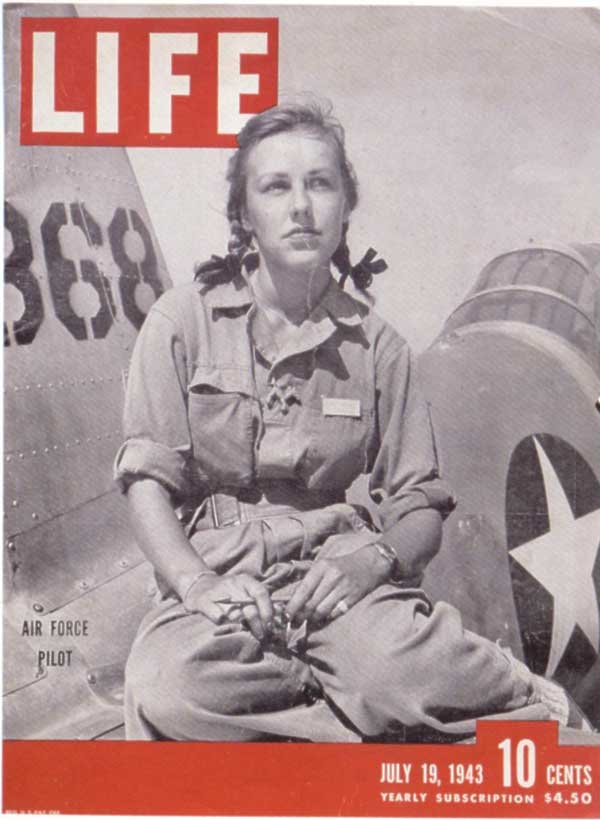
In 1943, she was hired by Douglas Aircraft and went to work in the tooling department. Eventually, she was promoted to cockpit installation.  While at Douglas, she saw a Life Magazine with a girl pilot on the cover.  When she read the article about WASP training program, she was thrilled and ready to sign up.

Because Betty Jo’s job at Douglas was considered ‘essential’ for the war effort, she had to get special permission to even apply for the training program.  After permission was granted, she was interviewed, passed all the required tests and was accepted for training as one of the ninety-eight women pilots in class 44-W-7.  

She paid her way to Sweetwater, Texas and arrived during one of the coldest winters in West Texas history.    Betty Jo described herself as “tall and skinny,” when she entered training.  On that  first awkward day at Avenger Field, one of her classmates affectionately gave her the nickname,  ‘Birdlegs.’  That nickname and the instant, comfortable friendship with her classmates stayed with her throughout her life.

On September 8, 1944, after seven months of training, Betty Jo and fifty-eight of her classmates graduated and received their silver WASP wings.   She received Army orders to report to the Eastern Training Command, Columbus Army Air Field, Columbus, Mississippi, where she flew Beechcraft AT-10’s and BT-13’s as an engineering test pilot, ferry pilot and administrative pilot.    

On Dec. 20, 1944, when the WASP were disbanded, Betty Jo paid her way back home and returned to a job at the Douglas C-54 plant as a test pilot.  
When an automobile accident temporarily grounded her, Betty Jo married Carl W. Reed.  They were blessed with two  boys and two girls.  

In 1957, the young couple opened the first McDonald’s franchise in Colorado--which was the third McDonald’s restaurant in the U.S.  A year after the birth of their fourth child, Betty Jo began flying again.  She earned her rating to fly Lear Jets and the King Air.   As their family business grew to ten McDonald’s,  eventually, she became a corporate pilot.  

Betty Jo competed in six Power Puff Derbies, winning a “Best in Class” from Flying Magazine.  She was a member of The Ninety-Nines, Inc., The Arizona Wing of the Commemorative Air Force, WMA (Women  Military Aviators) and the Air Force Association.   She served as President of the Phoenix Wing of the American Aviation Historical Society and was a docent at the Champlin Fighter Aircraft Museum in Mesa, Arizona.

In 1999, Betty Jo was inducted into the International Forest of Friendship and in 2010, she and her sister WASP were awarded the Congressional Gold Medal, the highest civilian honor Congress can bestow, for their pioneering military service during World War II.

Betty Jo is survived by daughters Melissa Reed of Aurora, Colorado and Sally Reed of Dallas, Texas; son John Reed of Deer Lodge, Montana; three grandchildren and one great-grandchild.  Her husband Carl Reed, son, Guy Reed, and two sisters preceded her in death.

A memorial service was held on Saturday, June 29th at 10:00 AM at St. Luke's Episcopal Church, 1270 Poplar Street, Denver CO 80220. 


 Respectfully posted by Nancy Parrish


sources:
Wings Across America’s Interview with Betty Jo Reed, Nov. 12, 2001
“Out of the Blue and Into History” by WASP Betty Turner  pp 465, 466
US Air Force News:   1/16/2006   
Denver Post, June 30, 2013


Personal note:

I met Betty Jo Reed for the first time in November of 2001, when mom & I traveled to Arizona to interview WASP for our Wings Across America project.  Betty Jo had agreed to meet us at one of her favorite places, the Champlin Fighter Aircraft Museum.  She was almost more excited about showing us all the wonderful airplanes than she was in talking about her life.  She was kind and so generous with her time, never complaining that we continued talking through lunch and into the afternoon.  In fact, we rolled tape until the museum staff had to lock the building up.  It was a delightful interview.

Betty Jo was a WASP who traveled to every WASP convention, the huge airshow at Oshkosh, to the Frontiers of Flight Museum when the WASP were honored on Veteran’s Day, 2009 and to Washington, DC  when the WASP were awarded the Congressional Gold Medal.   She was always upbeat, despite the health challenges and the battles to survive over the last few years.  She never gave up and always lifted those who were concerned for her. 

In September of 2012, Betty Jo called to see “what was going on.”  We chatted for a few minutes and then I asked her how she was.  That is when she shared that she was ‘not doing good,” and then immediately changed the subject to ask how mom and I were doing.  

Her question was so typical of this sweet lady, who has touched so many with her courage and her cheerful spirit. She spent only a moment on herself and then she asked how we were.  When I asked a few more questions, she shared her sad news about her fight with a second, much more deadly cancer than the one she successfully battled not long ago.  
During our interview in 2001, we asked Betty Jo, other than her family, what was the one thing she was most proud of?   Her reply:  “I’m most proud of my flying accomplishments.  I think that if you were to talk to some of the men that I flew with as a corporate pilot, they were surprised and proud.  In fact, they had bets on how long I’d last.  It made me proud of what I was doing.  I hand’t been very proud in my schooling--didn’t have much else to measure other than that.  I was very proud of my ability to fly.”
It was an honor to know Betty Jo...to laugh with her and listen to her stories.  She will be missed by all of us whose lives were touched by her gentle and encouraging spirit.  God bless you all.

Nancy