Sunday, March 1, 2015

Andrea C. Shaw, 43-W-8 | Jan 11, 2015


"I volunteered for the Air Force during the Korean conflict.  
I assisted, then became CO WAF Squadron of 200 ladies for three years."

Andrea C. Shaw was born in Bakersfield, California on March 18, 1919.  The facts of her early life story are brief, but her life was filled with service to her county, no matter what the challenge.

She entered WASP Training -- reported to Avenger Field, Sweetwater, Texas with 97 other hopeful young women pilots.  After approximately 6 months of Army Air Force flight training, she was among the 48 proud graduates of class 43-8.  She earned her silver WASP Wings and  assigned to Merced Field, California.

From Merced she was transferred to March AFB, California; Hamilton AFB in Bakersfield, California; Chico AFB,  Chico, California and Las Vegas, Nevada.  At Las Vegas, she transitioned into the B-26.  During her time as a WASP, she flew the BT-13, AT-6, UC-78, B-26 and A-24 (used by the Navy in the Battle of Midway).  She was also one of a select group of WASP sent to officer training school in Orland, Fl.

Following the deactivation of the WASP, Andrea took charge of the road accounting department for Kern County, California.  From 1951 to 1958, she volunteered to serve with the Air Force.  She became Commanding Officer of a WAF Squadron for 3 years and was then transferred to England, where she served as a finance officer at a small hospital base.

After leaving the Air Force in 1959, Andrea earned her real estate license but eventually, took a civil service examination and was assigned to Anchorage, Alaska as a customs inspector.  One of her most vivid memories was of the Good Friday Alaskan earthquake of 1964, which lasted 20 seconds and was classified 9.2 on the Richter scale.  She later said, "It make 'Christians' of a lot of folks.  It brought out the 'best' with everyone helping anyone in need.

Andrea retired to Redmond, Washington following her service in customs, and set up house on a small lake surrounded by wildlife and 'nice neighbors.'

Andrea later wrote of her life in Washington: "I have developed a liking for the challenge of building things. With no background for carpentry, I have managed to put a 10' x 12' dec and repaired a c'xi 16' second floor deck...nothing spectacular--but bound to outlast the Pyramids!

This special lady was truly one-of-a-kind.  She had a  lifelong love of country and neighbor.  She took pleasure in building things and the beauty of the world around her.  

God bless those whose lives she touched.  

Respectfully posted by Nancy Parrish
Wings Across America

Taken from Betty Turner's "Out of the Blue and Into History," p 249.


Monday, February 16, 2015

WASP Mary Nesbit Hearn, 44-W-6 | February 7, 2015

"I was absolutely convinced that they couldn’t win the war without me.  After all, It was a big effort and everybody had to pitch in and I wanted to do my share!    I was going to be a WASP!"
     WASP Mary Nesbit Hearn, 44-6 **

Born February 19, 1921, Mary Harriet Nesbit was the fourth of five children born to Navy Captain Donald W. Nesbit and his wife, Nancy Pike Nesbit. It was a comfortable household and as a military family, the Nesbit household moved often.

In 1927 Charles Lindbergh made his historic trans-Atlantic flight that electrified the world. When he stopped to visit Pensacola Naval Air Station, the officers and their families were invited to meet him at a reception held in his honor; and at the age of six or seven, Mary was not only awe stuck but in love, and sure he’d wait to marry her.

Shortly there after, a family friend, Admiral Rabie invited Mary and her older sister Nancy to a white glove dinner, and as the girls were saying “Thank you for a lovely evening”, Admiral Rabie pulled two small boxes from his pocket and gave one to each of the girls. The boxes held miniature gold naval aviator wings. The Admiral explained that he did not invite their brothers because they would eventually have the opportunity to earn their wings. But because girls could never earn them, he wanted to give them the miniatures as a gift.

Mary’s two older brothers graduated from the Citadel in June of 1941. The oldest received a direct commission into the Army, and the youngest of the two, not quite 21 went on to get his masters in engineering before joining Patton’s Army following graduation. Mary’s older sister got her Masters in political science, earned a scholarship to Buenos Aires for a year and was a translator during the war. Mary graduated from Chapel Hill, and the youngest brother joined his older brothers in the Army once he graduated from the Citadel.   

With the war in full swing and her brothers and sister involved in the war effort, Mary wanted to do her part. After asking to join the WAVE (Women Accepted for Volunteer Emergency) and having her father nix the idea, as not a fitting place for a “lady”,  she moved on to the idea of being going to Baltimore and building aircraft as a “Rosie the Riveter”. That was not well received either.

Mary saw an article in the Sunday Washington Post about the Women’s Airforce Service Pilots (WASP) and was immediately inspired. After her father reviewed the article, noting that 500 flight hours were required, and knowing her salary of $90 per month would buy little flight time, he gave his blessing. Regardless of how long it would take, she was elated to think she was on the road to helping her country win that terrible war. She started her lessons at a small airport outside of DC. She could take a bus and get to within a mile of the field and walk the rest of the way. Stretching it a bit, she could make one months salary last for six or seven lessons. She loved flying and soloed in nine hours.

She hit a snag when the government closed all civilian airports within 50 miles of the coast. But not to be deterred, she found a small airport... actually a grassy meadow, in Manassas, Virginia where she could continue her lessons. There was a daily train, and a railroad employee that had a rooming house that included Saturday night dinner and Sunday breakfast for a nominal price. Although the lessons with an overnight stay cost considerably more than the lessons at the local airport, Mary dipped into her savings and over a weekend she could pick up two hours of flying time on Saturday and two hours on Sunday and get back to DC on Sunday evening.

Her father’s plan to keep her occupied, but close to home, was sabotaged without warning... the Army Air Corp decided that women with 500 hours of flying time had developed habits that just didn’t comply with the “Army Way”; the flight time requirements were dropped from 500 hours to 35 hours! Mary was ecstatic! Only about five hours to go before she could submit her application! Just one final trip to Manassas!

With her log book and application in hand, she made her way to the WASP headquarters, Jacqueline Cochran’s office, in the Pentagon and begged them to send her to Sweetwater immediately. She didn’t realize that the WASP were swamped with over 25,000 applicants. Fortunately Mary had her degree from University of North Carolina, and met all the age, height and weight requirements. Each weekend she would show up at the WASP office, let them know she was packed and ready to go until they finally accepted her into the class of 44-5.

The long awaited departure day finally arrived and, her father took her to the train station for her trip to Sweetwater. Mary had orders to report to Avenger Field on his birthday, Dec 7. While saying their goodbyes her Father pulled out a wristwatch with a sweep second hand. It was one of the requirements for entering school, but she hadn’t put aside the money for it. It was his way of giving her his blessing.

A number of girls entering the class of 44-5 got off the train together in Sweetwater, made their way to the Bluebonnet Hotel and waited for the next mornings transfer in the “Cattle Car” to Avenger Field or better known as “Cochran’s Convent”. 

The new recruits were taken to an auditorium, the lights were turned down and they were told “look to your right, now look to your left” – “Only one of you will graduate”. Mary was terrified! The women were issued two men’s coveralls – size large – but they rolled up the sleeves, rolled up the legs and cinched in the belt and made do. Additionally they were issued two sheets and one blanket; rooms were known as bays, and there were six girls to a bay with one bathroom. I don’t think she will ever forget being awakened by the airplane engine noise from the flight line that she remembers as music to her ears, while the odor of gasoline was her perfume!

One of the bay mates was not quite ready for revile at six the first morning (she was doing her hair!); everyone was surprised and shocked when they returned from breakfast to find her mattress stripped and rolled up. She was gone - the first woman had been washed out of 44-5, but not the last.

Each class was divided into Flight 1 and Flight 2. Flight 1 went to ground school in the morning while Flight 2 flew, and in the afternoon it reversed. The PT-19, an updated version of the 90 horsepower WWI Red Baron plane, was the primary trainer. There was no starter; had a fixed landing gear, quite close together, making for tricky landings, touchy breaks, no intercom and an open cockpit. When the instructor tapped his head, he was in control; if he moved the stick back and forth, the student was to take over and repeat the maneuver he had just demonstrated.

After 70 hours in the Primary Trainer, it was on to the Basic Trainer – BT-13, best known as the Vultee Vibrator. It had a closed canopy, an intercom system and 350 horsepower – wow! What a step up! After another 70 hours, finally, the Advanced Trainer – the AT-6 with retractable landing gear, intercom system, 650 horsepower and a preflight check list of 28 different things that had to be memorized and actioned before the starter could be touched!

In the middle of Advanced Training, she was transferred to another instructor – she was terrified she was being washed out. She was told no, but it was suggested that she was lacking in upper body strength... so she added the gym to the already 16-hour days between flight school, ground school and study. In the advanced stage there was night flying and several cross country flights. 44-5 was getting close to graduation, but her final flight was a 2,000 mile cross country solo from Sweetwater, TX to Blythe CA. Getting caught in a nasty squall, with thunder all around and lightening dancing on her wings, she was sure she was a goner... Petrified, but steady, she held her heading, and managed to clear the squall.

The final written exams and check ride were closing fast. Morse code was more of an issue than anything else; map reading, engines and plotting courses all came easy, but those dots and dashes just wouldn’t fall into place for Mary. With help from her Bay mates’ drilling and quizzing she passed. With the final written exam behind her, it was now time for THE check ride... She as so intimidated by the Army Lieutenant performing the check ride - she was sure he would fail her – pass or fail? Wings or no wings? Oh, the shame of going home without her wings! There was a lot riding on that one hour check ride! She was so nervous she started to cry, went behind a shed and had her head buried in her hands when an instructor found her sobbing – “What the hell are you doing? Don’t you know that you wouldn’t be here unless we knew you would pass?   Now get out there and show them what you can do!”

She passed! 

Mary was 23; it was Jun 27, 1944 when 72 of the original 132 class of 44-5 graduated. Mary walked across the stage and was presented with her wings.

On one of her solo flights, she’d flown over a desolate little airfield, which wasn’t on the map, in fact she thought she was off course until she spotted Phoenix just ahead. There was not a blade of grass, not a tree, just desert. Come to find out it was Marana Army Air Base – her assigned base as an engineering  test pilot! She tested five planes a day, two in the morning and three in the afternoon testing their air worthiness. 

Little did she know that the desolate air field held the key to her happiness for the next 57 years.  You see, she met the love of her life, Lu Hearn, the very first day at Marana.

______________________

Mary took her last flight Saturday, February 7, 2015, just 12 days shy of her 94th birthday. 

 In reviewing her log book yesterday, I found the entry for February 7, 1944 – she had 3 ½ hours of flight time practicing the pylon course and doing lazy eights... 

Services to be scheduled at Arlington National Cemetery.

_________________

*Above article posted as submitted by Mary's daughter, Patti Macchi
** Quote from Mary's Wings Across America Interview

________________

Personal note: 

Mary Hearn was a gentle lady with a talent for making you feel at ease.  Such a lovely person and a delight to interview, which we were privileged to do in her Florida home in May, 2003.  

Below is a photograph from that trip.  Mary was unfazed as we unloaded all of our video equipment and placed it in her beautiful living room.  


Gracious is the word I will remember.  Mary was so gracious.

God bless her family and all of those fortunate to have known her.

Nancy Parrish

Friday, February 6, 2015

WASP Eileen Wright Ferguson, 44-W-7 | December 10, 2014


"My mother had an amazing memory for facts and details.  She could converse about Latin, opera, or horticulture, then turn around and name her students from all her years and their parents, sisters and brothers, then tell you about her travels naming sights, histories, the food, the people, and a plethora of detail on a vast range of subjects."             
             /s/ Scott Ferguson


Eileen Elizabeth Wright, daughter of Joicie Fay Wilson (Wright) and William Henderson Wright,  was born in Baltimore, Maryland on September 11, 1920. 

As a young girl growing up in Baltimore, Eileen was bright and active.  Her mother fashioned her daughter’s  handmade dresses with matching bloomers underneath, because the young girl loved doing handstands.  

During 4th and 5th grades, Eileen was moved ahead of her class, skipping several semesters of school.

After graduating from high school, she worked for an insurance company and attended secretarial school, eventually taking a job with Baltimore Gas and Electric.  

When America was thrust into World War II, Eileen wanted to do more for her country, but her job was considered essential.  When her childhood friend, Lila Moore, told her about the WASP training program, the two young women began taking flying lessons on weekends until they had the required number of hours to apply for the WASP. 

After applying and passing the entrance exam, the physical exam, and the required personal interview, Eileen and Lila were both accepted into the WASP training program as members of WASP Class 44-W-7.

In February of 1944, one of the coldest winters in West Texas history, the two friends, together with 101 other hopeful young women pilots, arrived in Sweetwater, Texas.  Over the next seven months, Eileen completed WASP training and graduated on September 8, 1944.

Eileen's Army orders sent her to Columbus Army Air Field in Columbus, Missouri, where she reported for duty with the 30th Flying Training Wing, which was a   part of the Army Air Forces Eastern Flying Training Command.  There she flew AT-10's (flight testing, ferrying, and as an administrative pilot).  

Eventually, Eileen was sent to Avenger Field for advanced training.  She remained there until the WASP were disbanded on Dec. 20, 1944.

Although her Christmas that year was sad, Eileen remained hopeful, applying to 30 different airlines for a flying job.  Unfortunately, the only job she was offered was as a basic flight simulator instructor.

In 1948, on a cross-country trip to California, Eileen decided to enroll at Pasadena City College.  She soon earned her Associate's Degree.  After graduation, she enrolled at UCLA, where she earned her B.A. Degree in Education, with a minor in Latin.  In 1950, she began teaching school at Repetto Elementary School and continued her education at Cal State.  Eventually, she earned a Master's Degree in Education.

As a teacher, Eileen was free each summer to travel, which is one of the reasons she chose teaching as a career.  On one of her trips, she met and fell in love with artist Ben Ferguson, a decorated, medically retired WWII Army Captain, at a local art show.   After dating for several months, they were married at the American Cathedral in Paris in 1956.  

Eileen eventually returned to the US to begin teaching again.  Her husband,  Ben,  joined her in California for a short time.  Scott Todd Ferguson, her only son, was born in August, 1959,  Soon after, the couple divorced.

For three decades, Eileen Wright Ferguson served as a teacher:  16 years of first graders, one year of teaching combined 1st, 2nd, and 3rd grades,  and thirteen years teaching 2nd graders.  At one point, she was chosen the “Southern California Representative for the National Education Association”.   
As her son, Scott, said:

"She had an amazing memory for facts and details.  She could converse about Latin, opera, or horticulture;  then turn around and name her students from all her years in teaching and their parents, sisters and brothers;  then tell you about her travels-- naming sights, histories, the food, the people, and a plethora of detail on a vast range of subjects!  She also had a sharp wit with a ready wry comment.  She was interested in Art, Science, and Current Events;  was a voracious reader;  she played bridge; and was a  letter writer with hundreds of friends and pen pals.”

After retiring, Eileen traveled extensively, visiting art museums, gardens, and galleries, and attending plays and operas.   She was invested in sharing the culture of her community, serving as a docent at a Pasadena museum until her health kept her from climbing stairs.    Eileen was also a life long member of the Methodist Church.

Eileen Elizabeth Wright Ferguson passed away December 10, 2014 with her son, Scott, by her side.  Her ashes will be partially scattered over her parent's graves at Woodlawn Cemetery in Baltimore, MD and inurned in a niche at Arlington National Cemetery, date tbd.

Eileen's legacy of service, not only to her country, but to her community and to the lives of countless young students she inspired with her colorful stories of remarkable things she had witnessed, will live on.

Our hearts go out to Scott and to all of those who were touched by this WASP: patriot, teacher, mother.  God bless you all.

Respectfully posted by Nancy Parrish
with Scott Ferguson 


Wednesday, January 14, 2015

Flora Belle Smith Reece, 44-W-4 | December 1, 2014


 "God is the center of everything I do.
That's who I am."

WASP Flora Belle Smith Reece, 44-W-4
October 21, 1924 - December 1, 2014


_______________________________________


Article below respectfully reposted with thanks to Rebecca Amber, Edwards AFB 
and the Antelope Valley Times, Lancaster, CA.

_______________________________________

W.A.S.P., 90 years well lived

EDWARDS AFB – Antelope Valley residents said ‘goodbye’ to World War II-era Women Airforce Service Pilot and Congressional Gold Medal recipient Flora Belle (Smith) at the age of 90. Reece died peacefully in a UCLA medical facility after being removed from life support.

Those who knew Reece well will remember she had three priorities in life: God, family and aviation – in that order.

Reece was born Oct. 21, 1924, in Sayre, Oklahoma, during the Great Depression. She had three siblings James Evan, Mary Lea and LaWanda. Her parents, Robert and Agnes Smith were sharecroppers.

As a toddler, Reece would ask to hold her baby sister LaWanda and when she’d had enough, she’d stand up, “dumping LaWanda unceremoniously on the ground.”


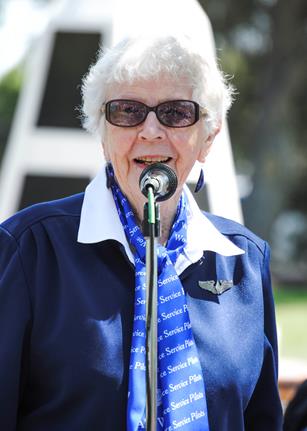
Women Airforce Service Pilot Flora Belle (Smith) Reece spoke at the W.A.S.P. memorial dedication at Lancaster Cemetery in 2011. (Aerotech News photo by Rebecca Amber)
WASP Flora Belle (Smith) Reece spoke at the W.A.S.P. memorial dedication
at Lancaster Cemetery in 2011. (Aerotech News photo by Rebecca Amber)
According to her daughter Connie Fox, Reece “Kept the adults watching her closely. She basically did as she wished and everyone around her scrambled to make sure all was okay.”


Her father was a Southern Baptist preacher and her mother a homemaker. Before she entered kindergarten, Reece was assigned regular chores like keeping the kindling box full for the cast iron stove.

Her son, Russell Reece, remembers hearing stories about a cow that had to be milked three times a day. The cow would come as close to the house as she could and bawl for Reece’s father to come milk the cow.

Later on, she was assigned to plowing the fields.

“She would guide the horse to the end of a row, wait for her older brother Evan to turn them around to start the next row,” said Fox.

And as she plowed, she would look to the skies, watching the birds as they effortlessly soared by. She knew that like the birds, she wanted to fly.

When she told her father, as a young girl, that she wanted to fly, he would respond, “Flora Belle, that isn’t something girls usually do, but if you can figure out a way to make it happen, more power to you.”

In school, when Reece was told to write down what future career she would like to pursue, she would write “pilot.” This resulted in being called into the office and told that girls could not be pilots and that she would need to choose something more practical.

“Never once did her enjoyment of or her desire to fly waiver,” said Fox.

During her senior year in high school, Pearl Harbor, Hawaii was bombed by the Japanese.

Young Flora Belle (Smith) Reece is shown between fellow classmates after graduating from B-26 school in Harlington, Texas. Reece was younger than her classmates because she entered the service at 19 when the minimum age was 21. (U.S. Air Force photo)
Young Flora Belle (Smith) Reece is shown between fellow classmates 
after graduating from B-26 school in Harlington, Texas. Reece was younger
 than her classmates because she entered the service at 19 
when the minimum age was 21. (U.S. Air Force photo)
After graduation, she responded to a notice that  Jacqueline Cochran had placed in the local papers looking for 21-year-old women to fly military aircraft for the Army. She sent for her birth certificate, knowing it would be a few years before she was old enough to join. However, someone in the county clerk’s office mistakenly put her older sister’s birth year on the document, making her eligible right away.

After being interviewed and given a physical, she was told she would need 35 hours of flight time logged in order to join the W.A.S.P.

Reece once mentioned in an interview that it was as if he’d asked her for the moon because the cost of flying was so high. Her older brother, an Army lieutenant, was the answer to her problems when he agreed to lend her the money for private flying lessons.

As a W.A.S.P. trainee, Reece was assigned to a bay with five other women at Avenger Field in Sweetwater, Texas. She was often teased about looking young by the other women who did not know she was only 19.

“After about six weeks, she couldn’t stand that she’d entered W.A.S.P. illegally and went to the commanding officer,” recalled Fox.

Since the age requirement was set to be lowered and she was doing well in her training, the issue was dropped.

On the day that she soloed in the North American T-6, Reece forgot to pick up her instructor and bring him back to the hangar. She ran out to meet him, offering to carry his parachute, although he declined.

Then one rainy day, that same instructor allowed her climb through an opening to fly above the clouds because “Flora Belle never gets lost.”

The wide open space was wonderful for practicing her acrobatic maneuvers. But, after rolling and spinning, her hole in the clouds was gone and she was lost. As she had been instructed, she found a farm with phone lines and prepared to land, worried that she would be sent home if any damage came to the airplane.

She was met by local farmers who helped her call the base and put on an impromptu potluck. The next day, she was picked up by her instructor and a mechanic in a cattle truck. The most embarrassing part of the whole experience was carrying her parachute in that morning, because everyone could see she didn’t make it back in time to turn it in the day before.

For weeks, Reece thought she would wash out of the program, and when she could not stand it any longer, she asked her instructor about it.

As it turned out, he had known for weeks that everything was fine.

When she asked why he waited so long to tell her, he said, “Remember my having to walk back to the hangar carrying my parachute? Now we’re even.”

Of the 25,000 women who applied, less than 1,900 were accepted and only 1,074 earned their wings. Reece graduated with hers in May of 1944 with Class 44-W-4 and served until the W.A.S.P. was disbanded in December of that same year.

W.A.S.P.s Flora Belle (Smith) Reece and Dorothy Allen put on make up in the reflection of a P-38.  (U.S. Air Force photo)
W.A.S.P. Flora Belle (Smith) Reece and Dorothy Allen
put on make up in the reflection of a P-38. (U.S. Air Force photo)

It wasn’t until 1977 that the W.A.S.P. were granted full military status for their service. Prior to that, they had been considered civilian pilots. In 2010, they were presented with the Congressional Gold Medal for their distinguished achievements. Both Connie and Russell were in attendance at the ceremony in Washington D.C.

Though she appreciated the gesture, Reece once remarked that she would have preferred to have been given military status at the time, so she could have continued flying.

Reece spent the majority of her time as a W.A.S.P. flying the North American AT-6 “Texan,” which she called a “beautiful airplane.” Her assignments usually involved transporting non-flying officers, photographers for the newspaper and chaplains wherever they needed to go. She was later trained to fly the B-26, known as “the widow maker,” which she used to tow targets for gunner’s practice.

Her dream though, was to fly the P-38. She was never given the chance, but she was certainly ready for it. When ace pilot Maj. Richard Bong toured a base she was stationed at, she convinced the ground crew to let her sit in the cockpit so that she could memorize the instrument panel.

She was finally afforded the opportunity to ride as a passenger aboard a P-38 in Burbank, Calif. at the age of 79.

After leaving the W.A.S.P., Reece returned to Oklahoma in 1945, where she married her high school sweetheart Ralph, an Army Air Force mechanic. The two moved to California and had their first child, Connie. They were married for 62 years before Ralph’s passing, and they gave birth to two more children, Cherryl and Russell.

“Mom taught us to help others. She stressed this particularly in regard to including unpopular school mates in activities,” recalled Russell. “At one time a school [administrator] commended Connie because Connie had included a minority student in some activity in the face of considerable peer pressure.”

Years after moving to California, Reece went to school, got her credential and became a teacher. She taught math at several schools, including Park View School in Lancaster. At that school, she started the first computer lab using Apple IIe computers and attempted to recruit the support of other teachers. Only one of those teachers would allow her students to turn in type-written homework assignments. The rest insisted that computers were “just a fad.”
In their retirement years, the Reeces spent two years with the Peace Corps in Malaysia, India and Thailand.

Even after Ralph’s death, Reece continued to find ways to serve others. In 2009, she went with a group from Faith Community Church to the Philippines.

For years, she presented photographic slides from her W.A.S.P. days to military groups, schools and community organizations. She was an active member of the Antelope Valley 99s, the P-38 National Association, and participated in many W.A.S.P. functions.

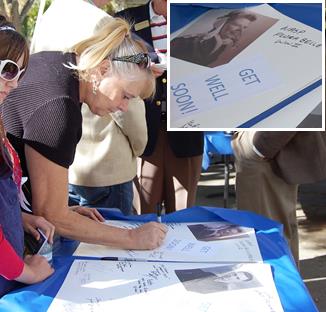
At a 2014 Veterans Day ceremony at Lancaster Cemetery, attendees signed a “Get Well” card to be send to Reece. Less than a month later, Reece died peacefully in a UCLA medical facility after being removed from life support.
At a 2014 Veterans Day ceremony at Lancaster Cemetery, attendees signed a “Get Well” card
 to be send to Reece. Less than a month later, Reece died peacefully in a UCLA medical facility
after being removed from life support.

Reece also stayed very connected to Edwards AFB.

“I recall young men assigned to Edwards coming to the house after church or for church-sponsored activities for many years,” said Russell.

Reece was one of four W.A.S.P.s who lived in the Antelope Valley. The other three were Margaret (Castle) McAnally, Irma “Babe” Story and Marguerite “Ty” Hughes Killen.

A memorial with pictures of all four women is in the Lancaster Cemetery Veterans Court of Honor.

Reece is survived by her daughter Connie, her son Russell, four grandchildren and five great-grandchildren.

“God is the center of everything I do,” said Reece in a former interview. “That’s who I am.”

________________________________________


Friday, October 10, 2014

WASP Ruth Glaser Wright Gushe, 44-W-10 Oct. 4, 2014


"I have always felt that the WASP experience was the greatest achievement in my life and everything thereafter was anti-climatic!  ...I still look to the sky at any sound of aircraft, and remember the good old days..."   WASP Ruth Gushe' * 


Ruth Glaser Wright Guhsé passed away on October 4, 2014 in Athens, Georgia. Born Ruth Nydine Glaser on December 31, 1923 in Los Angeles, California, Ruth was a wife and mother of two children. She is survived by her son, David Wright of Athens, Georgia (wife Anette) and her daughter, Melinda Pomeroy of Portland, Oregon (husband Jeff) as well as three grandchildren (Solomon Weil, Ella Weil, and Jacqueline Wright) and two great grandchildren (Zidane Indarta and Raza Indarta).

Ruth had an early love of flying that developed because she lived near Clover Field in Santa Monica and Mines Field, which is now Los Angeles International. Part of her desire was, no doubt, due to publicity about Amelia Earhart and Charles Lindbergh. She eventually learned to fly with a group of women with whom she worked at North American Aviation. Because they were unable to fly on the coast they drove out to Baker, California after work on Fridays and returned on Sunday nights. She learned to fly in a 65 hp Porterfield and also took some time in a Meyers OTW, so as to familiarize herself with an open cockpit. After learning to fly she joined the Women's Airforce Service Pilots (WASP).

After all the tests and the physical, she was assigned to 44-10, the "Lost Last Class of Avenger Field." At Sweetwater, Texas, they received primary training in PT-17s and then transitioned to AT-6s.  She did instrument training in BT-13s and then flew AT-6s again for advanced and cross-country training. After graduation she was assigned to Aloe Army Air Field in Victoria, Texas, for tow-target duty and was there when the WASP were deactivacted.

After deactivation, Ruth was hired by Pan American Airlines as a stewardess and purser. She flew extensively across the Pacific to Hawaii, Fiji, New Zealand, Australia, Midway, Wake, Guam, Manila, Bangkok, Calcutta, Hong Kong, Shanghai, and Okinawa. In January of 1948 she married Jack Wesley Wright. They took over a flight school in West Sacramento-Capitol Sky Park, but within a couple of years, her husband was diagnosed with cancer. He passed away in 1961.

In 1956, she returned to work. She worked for 31 years as an office manager/financial manager in the construction and architectural fields. In 1964 she married F. Ross (Dick) Guhsé. They were married for 23 years; she was stepmother of Lynn, David and Laurel and step-grandmother to Jason Guhsé. Her husband Dick passed away in 1987, also from cancer.

In 1987 she started traveling, returning to Australia, New Zealand and Hong Kong. She also took tours to Kenya and Egypt, Indonesia and Bali, the Greek Isles, Ireland, China, South America, and Tahiti. With another former WASP, Emily Kline (44-1), she flew around the world in 1997. They started with Hong Kong for the Chinese take-over, then on to India and the Taj Mahal, London and the theater, and then back home.  She also attended many WASP reunions.

Ruth moved to a retirement community in La Jolla in 1999 where she could look out her balcony and watch the huge waves breaking onto the shore. In 2006 she moved to another retirement community in Portland, Oregon so as to be closer to her daughter. In 2009 she moved to Athens, Georgia to be close to her son and his family.

Ruth always felt that the WASP experience was the greatest achievement in her life and everything thereafter was anti-climactic! She made life-long friends there and over the years enjoyed using her computer to keep in close contact with her WASP friends. In 2010 she and the other WASP were awarded the Congressional Gold Medal. She also held membership in the Ninety-Nines and the Women Military Aviators. To the end she still looked to the sky at any sound of aircraft and remembered the good old days.


Ruth’s remains will be inurned at Arlington National Cemetery. Remembrances can be sent in the name of Ruth Glaser to the WASP Endowment.

_________________________________

Reposted with great respect by Wings Across America. 

* Quote from WASP Betty Turner's "Out of the Blue and Into History,"  p. 560  Aviatrix Publishing Inc., 2001