Friday, March 29, 2013

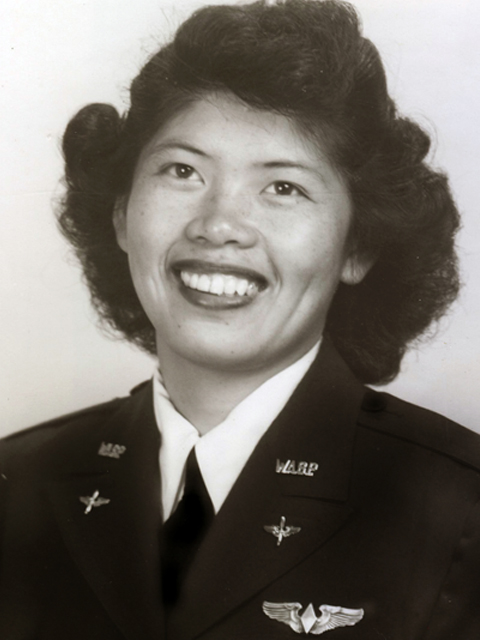
Lois Maxine Dobbin Auchterlonie, 43-W-8 March 24, 2013


Lois Maxine Dobbin Auchterlonie, 43-W-8


Lois Maxine Dobbin was born April 14, 1917 on a farm East of Viola,  Kansas to Thomas M and Alma R. Dobbin.  She grew up in Wichita, Kansas.   

Lois graduated from East High in Wichita, Kansas and later attended Wichita State University, where she was President of the Delta-Omega Sorority in her senior year.   

In 1941, while still enrolled in college,  she had the opportunity to take the CPT (Civilian Pilot Training) program.  After earning her Bachelor's Degree and her civilian private pilot's license,  she went to work at Boeing’s Stearman Plant in Wichita.  It was there she heard about the WASP program to train women pilots to fly military aircraft.

Lois applied and was accepted for military flight training in class 43-8. In 1943, she paid her way to Avenger Field, Sweetwater, Texas, to enter the Army Air Force training program for women pilots.   Of the 95 women pilots who entered class 43-8,  Lois was one of only 48 who successfully completed the six months of training and graduated.  

After earning her silver WASP wings, Lois received her official AAF orders,  sending her  to Williams Field, Arizona for duty as an AT-6 engineering test pilot.   During her career as a WASP, Lois flew the PT-17, PT-19, BT-13, AT-6, UC-78, AT-9 AND AT-11.  Her dedication and service, together with that of the other Women Airforce Service Pilots,  released hundreds of the Army Air Forces desperately needed male military pilots for combat duty. 

After the WASP were deactivated, Lois built a career around aviation-related jobs:   working at flight schools; writing pilot flight manuals at North American (AJ-1 and XA25-1); working as a secretary for an aircraft parts service company in Wichita;  and eventually working for over thirty years  as a technical editor and proposal coordinator for Raytheon in Massachusetts.

In 1981, Lois became a charter member of the Women Military Aviators (WMA), an organization that included both WASP and other women military pilots.  She helped write the original by-laws and continued networking with members from  various flying branches of the military for many years.

Lois enjoyed flying her own Cherokee 180 for over twenty years.  She was very active in the Ninety Nines (international civilian women pilots) organization,  and helped manage the All-Women New England Air Race for several years.  She flew co-pilot in the 1961 Powder Puff Derby from Calgary,  Canada to Baton Rouge, Louisiana, and In 1972, Lois entered and won the All-Women New England Air Race. 

Lois met her husband, Charles Auchterlone in college.  Later,  they married and made their home in Acton, Massachusetts until Charles retired.  In 1987   the couple moved to Anacortes, Washington.  They were married for 32 years.

After she lost her husband, Lois spent her time fostering cats needing new homes, as well as serving as the volunteer treasurer at the church thrift shop and treasurer for a church women's group.  She remained active in the local community club as well as playing a few rounds of golf.  However, she referred to attending the WASP and WMA reunions as "The highlight of my year."

In 2010, Lois, together with her sister WASP, was awarded the Congressional Gold Medal for her service as a pilot during World War II.  

++++++++++++++++++

Lois passed away peacefully on March 24, 2013 following a fall at her home in Snohomish Washington. She is preceded in death by her parents, her husband,  and her brother.  She is survived by brother-in-law, Kenneth Auchterlonie and numerous nieces and nephews.  

A Memorial Service will be held at 2:00 pm, April 20, 2013 at Evergreen Funeral Home, 4504 Broadway in Everett. 


In lieu of flowers, the family asks that donations be made to the Animal Shelter of your choice.

v/r posted by nancy parrish
from Betty Turner's "Out of the Blue and Into History" p. 267 and Byrd Granger's "On Final Approach."  
Photo from the Wings Across America digital archive.

Thursday, February 14, 2013

Helen Wyatt Snapp, 43-4 Jan. 20, 2013

“There’s nothing like flying. I would encourage anyone to at least try it.    There’s nothing like being up there by yourself.  You’re never closer to God than when you’re up in the sky.”              WASP Helen Snapp
WASP Helen Wyatt Snapp, a graduate of Class 43-W-4 of the Women Airforce Service Pilots, passed away on Jan. 20, 2013.  She is truly flying higher than she has ever flown before.

Born May 1, 1918 in Washington, DC, Helen was the middle child in her family, with two older sisters and a younger brother and sister.  At age eight, young Helen sat on a curb on Pennsylvania Avenue and watched as aviation pioneer Charles Lindbergh, rode by in a ticker-tape parade.  Her brief glimpse of the aviation pioneer, who had just returned from the world record setting first solo flight across the Atlantic, remained an inspiration throughout her lifetime.

After high school, Helen attended Mary Washington College in Fredericksburg, Va, planning to become a teacher.  However, on summer break, she saw an ad in the paper for flying lessons.  She convinced her sister to join her and, without telling the rest of the family, they signed up.   Eventually, they both soloed. Helen then dropped out of college, used her part-time pay (working for the telephone company)  to pay for more flying time.  She eventually re-enrolled in college to take advantage of the CPT (Civilian Pilot Training) program.  CPT  gave her the opportunity to build up her flying hours and to attend ground school classes at night. 

After the attack on Pearl Harbor, early 1942, Helen married her beau, Ira Benton "Ben" Snapp and put her flying on hold.  After her husband graduated from officer training, he was shipped overseas with the 3rd Infantry.

In early 1943, she received a telegram from aviatrix Jacqueline Cochran, inviting her to apply for the newly created Army Air Forces flying training program for women pilots.  She was interviewed by Ms Cochran  at the Mayflower Hotel in DC and accepted.
"Before I knew it, I found my way to Texas.  I had never been away from home before...it was quite an experience just to take that step.  But I was just thrilled to pieces, because I just loved to fly.  And here I was going to be able to fly all those wonderful military airplanes!"
On Feb. 4, 1943, Helen, together with half of her class of 151 young women pilots,  reported to Avenger Field, Sweetwater, Texas for military flight training,.   At that time, there were male Canadian cadets in training there at Avenger Field and living in some of the barracks.  They were  soon shipped out to other bases, leaving room for the other half of Helen’s class to report to Avenger Field.

After completing the required six months of flight training, which was essentially the same training as the male Army Air Force Cadets were receiving,  on Aug. 7, 1943, Helen and 111 classmates graduated, received their silver WASP wings,  and became WASP--Women Airforce Service Pilots. 

Shortly after graduation, Helen and a group of other WASP were given temporary orders to report to the Pentagon.  After a week of briefing, they, received orders to report to Camp Davis Army Air Field, North Carolina, an anti-aircraft artillery school.  After transitioning into A-24's and A-25's, Helen flew tow-target missions over the Atlantic, as gunners on the beach fired live ammunition at her cloth target.  (She also flew radar, searchlight, tracking and strafing missions.) 

After completing the transition training at Camp Davis,  she was sent to Liberty Field, near Camp Stewart/Savannah, Georgia.  She and five other WASP were selected for ‘R-Flight’--  a top secret initiative located on an “off-limits” part of the field. There, she learned to “fly” a PQ-8 & PQ-14, which were radio controlled drone aircraft,  from a console inside an AT-11 or UC-78 control ship.  (In time, this led to the development of the more sophisticated remote-controlled planes used by the Air Force today.)

By the time the WASP were disbanded in Dec. of 1944, Helen had charted over 1,000 hours in her log book, including time in the PT-19, BT-13, AT-6, UC-78, P-34, B-17, PQ-8, PQ-14  and her favorites, the A24 “Douglas Dauntless” and the A25 “Hell Diver.”

After her WASP service was over, Helen arrived back in DC, her husband, now Captain Ira Snapp, returned from overseas duty and retired.   The couple settled down on a family farm near Staunton, Virginia.  Helen gave up flying, went to work for the US Post Office,  and they began their family, which eventually included three sons.

During her later years, Helen raised Pekingese dogs and was an avid gardener—and, as she pointed out, “flowers and vegetables.”  She became active in the National WASP organization, serving as National Treasurer from 2002-2004.  She was a proud member of the Ninety Nines, The Valiant Air Command, and was a fan of the women astronauts, attending several shuttle and rocket launches near her home on the east coast of Florida.


In 2010, the WASP were awarded the Congressional Gold Medal, the highest civilian honor Congress can bestow.  Florida Representative Illeana Ros-Leitinen, the co-sponsor of the bill in the House, presented a signed copy of the Congressional Bill to Helen in her home in Pembroke Pines, Florida.  Helen was touched by her kindness and overwhelmed by the honor.  (Charles Lindbergh, who had inspired her to fly,  had previously been awarded the same medal.)

Helen spent the last few years as a sought-after guest speaker at many different events, sharing her stories about her service as a WASP.  This past December, she attended the Wings Gala at Wings Over The Rockies Aviation and Space Museum in Denver, Colorado, where the Fly Girls of WWII Traveling WASP Exhibit is on display.

Helen passed away at Memorial West Hospital in Pembroke Pines, Florida, following complications after surgery to repair a fractured hip.   She is survived by her sons:  Jeremy and David;  daughter-in-law Adriana;  and grandchildren Robert, Benton and Justin.  She is also survived by nieces and nephews:   Hal, Bob and Leilani Henderson; George, Michael and Larry Yates; Don, Diane, Christine and Bobby Walker; Martha Hillegas,  and Sue Taylor.

Those of us who were blessed to meet Helen will always remember a generous and caring lady, with an easy laugh and kind, sparkling eyes. She found great joy in sharing her love of flying and always spoke straight from her heart. She will be missed.  She will be remembered.

A Memorial Service in celebration of Helen’s life will be held March 2, 2013, 11:00 am at 14710 SW 128 Street, Miami, FL 33196.  Fly-in’s will be accommodated with RSVP to office.  (Call 305 233-5197 to arrange for incoming planes. )

In lieu of flowers, donations can be made to Wings Over Miami, 14710 SW 128th Street, Miami, FL 33196 and/or Florida Gold Coast  99s , 880 N.E. 69 St. #4F, Miami, FL 33138.

Respectfully written and posted by Nancy Parrish

___________________


Sources:
Betty Turner’s “Out of the Blue and Into History”  p. 89 “Helen Snapp in Her Own Words”
North Carolina’s WWII Experience: Helen Snapp/WASP
Veteran’s History Project: Interview with Helen Snapp (5/23/2011)


Monday, February 4, 2013

Maggie Gee, 44-W-9, Feb 1, 2013.

 "When I was growing up, my heroes were Amelia Earhart and Charles Lindbergh.   I loved to watch airplanes fly."
WASP Maggie Gee

Margaret "Maggie" Gee, whose Chinese name was Gee Mei Gue, was born on August 5, 1923 in Berkeley, California, the daughter of a successful Chinese importer and a first generation Chinese-American.  Maggie’s grandparents (on her mother's side)  had been fishermen who immigrated to the United States to escape the Taiping Revolution and settled in Chinatown, where her parents met and married.  However, her father did not want to raise his family in Chinatown, so before Maggie was born, he moved his family to Berkley. 

When the stock market crashed in 1929,  Mr. Gee had a heart attack on a San Francisco street and died shortly thereafter, leaving behind a wife and six children.  Maggie’s formative years were spent witnessing her mother take on greater and greater responsibility, not only raising six children and working, but remaining actively involved in her church and her community.

When America entered WWII,  Maggie  passed a drafting test and left her first year of college to work at the Mare Island Naval Shipyards in Vallejo, California.  There, she worked as a draftsman for the engineers who were working on classified projects on US Naval ships needing repair.

By 1942/43, Maggie had saved enough money to move to Minden, Nevada, to learn to fly.  She paid $800 for six months of training and fifty hours of flying time.   After she soloed and flew the required hours,  Maggie applied for the WASP flying training program at Avenger Field, Texas and was accepted into class 44-W-9.
 
In June, 1944, Maggie left her home in San Francisco and boarded a troop train which was filled with soldiers at Berkley, California.  For the next two days, she either sat on her suitcase or stood up -- all the way to Sweetwater, Texas.  There 107 women pilots who entered the same class with Maggie; however,  only   55 earned their silver wings and graduated as WASP (Women Airforce Service Pilots)  on November 8, 1944.

After graduation, Maggie was sent to Las Vegas Army Air Field, Nevada, where she served as a tow target pilot for flexible gunnery training for male cadets until the WASP were deactivated on December 20, 1944.  She then returned to Berkley and completed her formal education, after which she traveled to Europe and was in charge of a European Service Club in the early 1950's.

When Maggie returned to the United States, she began her life as a physicist/researcher, working and studying at the UC Berkley and at its National Laboratory in Livermore.  Her research covered the fields of cancer, nuclear weapons design, fusion energy, and other related fields.

Maggie's lifetime passion for politics began in the Truman Administration,  and she continued her work by supporting voter registration and fundraising, serving on the Berkley Community Fund, the Alameda County Democratic Central Committee, and as a board member of the Berkley Democratic Club in Berkeley,CA.  She also served on the California Democratic Party Executive Board and Asian Pacific Islander Democratic Caucus.
"I’m very optimistic about the world and people... it will be all right...You can make changes.  I think just one small person can make a little bit of change..."
Maggie Gee passed away on Friday, February 1, 2013.   She is survived by her nephews:   Dale, Dwayne and Gene Chung.  A memorial service will be held in Oakland, California -- date to be determined. In lieu of flowers, donations may be made to Planned Parenthood.

Maggie's legacy will live on in the lives of all of those she educated and changed with her passionate patriotism and her extraordinary sense of social justice.  

Respectfully written and posted by Nancy Parrish
Feb. 4, 2013


WASP Betty Turner's "Out of the Blue and Into History"

Rosie the Riveter World War II American Homefront Oral History Project: An Oral History with Maggie Gee conducted by Leah McGarrigle, Robin Li, and Kathryn Stine, 2003, Regional Oral History Office, The Bancroft Library, University of California, Berkeley, 2007.

Sky High: The True Story of Maggie Gee by
Marissa Moss, illustrated by Carl Angel

Thursday, January 31, 2013

Mary Louise Bowden Brown, 43-4 Jan.29, 2013

WASP Mary Louise Bowden Brown, 43-4, took her final earthly flight January 29, 2013.  She was ninety-six.  Today, she is flying higher than she has ever flown.

Born May 16, 1916, in Overbrook, Pennsylvania,  Louise became interested in flying after meeting the pilot/owners of Buck's Airport in Woodruff, New Jersey.  She accepted an invitation to join their flying club, which gave her the opportunity to solo  and build up her hours in a 50 hp Porterfield.

After hearing about the WASP training program, Louise applied and was accepted into the class of 43-4.  Of the 151 women pilots who entered the training program,  Louise was one of 112 women who graduated and earned their silver wings--August 7, 1943.  After graduation, she received Army orders to report to the Ferry Command at Romulus, Michigan. 

As Louise later wrote, * "We flew small planes at first and later larger and faster ones.  Among them the PQ-8 and YPQ-12A.  These were radio controlled.  Flee Wings built 12 of the YPQ and I delivered two from Wright Field.  Flew the PT-19, BT-15, AT-6 and C-467 for a white instrument card , them we were ched out in the five single fighters, P-39, P-63, P-40, P-47 and P-51, the Fairchild P-24, a Norseman, and a Howard."

After the WASP were deactivated (Dec. 20, 1944), Louise earned her instructor's rating, single and multi-engine ratings and taught flying for six years. Louise became a chaplain at a 125-bed hospital in Fulton, Kentucky, where she  ministered to young girls who were  serving time in the Hickman, Kentucky jail.  

Louise became a missionary for the Presbyterian Church, and  for 21 years, served at a 525 bed hospital in Maharastra, West India.  From West India, she transferred to Kathmandu, Nepal, where she served for four years.

After retiring, Louise  married Sam Brown and returned to Kentucky.  After Sam passed away,  she earned her black belt in Tae Kwan Do. A short time later, she moved to New Hampshire to be near her sister.   She  was a resident of The Kendel Nurshing Home in Hanover, New Hampshire and is survied by nephew Gordon Edgan and wife, Janis.

Mary Lousie Bowden Brown was an extraordinary patriot, a Christian soldier and a fearless pioneer.    May God bless all of those whose lives she touched-- and those of us who never had the opportunity to meet her, and are touched as well. 

 The Dash Between 

Respectfully posted by Nancy Parrish
* from "OUT OF THE BLUE AND INTO HISTORY" by WASP Betty Turner

Friday, January 25, 2013

Frances Caroline Gilbert Johannessen, 44-W-4, Jan. 7, 2013

Frances Caroline (Gilbert) Johannessen 44-W-4

Fran, born Oct. 28, 1920 in San Antonio TX, took her last flight Jan. 7, 2013 in Novato CA.

While attending college on a music scholarship, she had the opportunity to take flying lessons. Her love of flying enabled her to serve as a WASP, during which she met the love of her life, Norm (John Norman Johannessen), at Merced (CA) AAF. Norm had opted for pilot training after serving 50 missions as a nose gunner/bombardier in B-17s out of North Africa.

After the war they married and settled in Huntington NY. Fran (or Tex, as she was known to many of her friends there) was a wonderful mother to her 3 children. She played the violin in the Huntington Symphony Orchestra along with Norm on the trombone. They joined a bridge club, attended many functions at the Huntington Fire Dept. where Norm volunteered, and took up golf, which became their favorite pastime.

Fran was a Cub Scout den mother, worked for the Huntington School District, took up oil painting, and volunteered driving for Meals on Wheels.

Following Norm’s death, Fran moved to CA to be near her sons Jerry (Chris) in Novato CA and Bob (Carol) in El Sobrante CA. Daughter Jean Skerlong (Joel) lives in Mukilteo WA. Fran also leaves behind five grandsons, Erik, Sean, Michael, Jason and Carl, and one great granddaughter, Claire.

Her family will truly miss her kind smile, her always positive attitude and her exceedingly humble spirit. When the WASP were awarded the Congressional Gold Medal in 2010, she said she did it just because she wanted to fly!

written by Jerry Johannessen

Emily Porter Kline, 44-1 Dec. 20, 2012

Emily Kline, longtime Kinnelon resident who flew for military during WWII, dies at 92


Thursday, December 20, 2012    Last updated: Thursday December 20, 2012, 10:12 AM

The Record
Emily Kline, among a select group of patriotic women who flew military aircraft during World War II, died Friday. The former Kinnelon resident was 92.


"At first everybody thought we were a joke," Mrs. Kline said in a 2004 interview with the Star-Ledger. She was referring to the Women's Airforce Service Pilots, or WASPs.
"Eventually we earned the respect of the people who mattered: other pilots."
The volunteer WASPs — there were 1,074 — flew all types of planes for the Army Air Forces, filling in stateside for male pilots sent to combat. They are considered pioneers now but were treated as second-class at the time. The women stitched their own uniforms and paid their own way to training bases.

Mrs. Kline, then Emily Porter, learned to fly while working as a secretary for Sinclair Flying Service in Muskegon, Mich. She spent a good deal of her WASP tenure as an engineering test pilot at an Army air base in Greenville, Miss., said Nancy Parrish, director of Wings Across America, a multimedia and digital history project devoted to the WASP.  Parrish, whose mother, Deanie Parrish, served in Mississippi with Mrs. Kline, estimated that 200 to 230 members are still living.

The WASPs gained military veteran status in 1977 and were awarded the Congressional Gold Medal in 2010 at the Capitol. Mrs. Kline attended the ceremony and displayed her medal in her living room.
KLINE"She was thrilled the WASPs had finally gotten recognition from the government," her son Thomas said.

Mrs. Kline lived in Kinnelon for 45 years and worked in her husband Charles' marketing consultant firm. Charles Kline died in 1992.

"At 82, when most people downsize, Mom decided to supersize, so she sold her home in Kinnelon and purchased a 100-acre farm in Frelinghuysen Township," her son said. "In part, she was trying to get back to her roots — she grew up on a farm — but she liked the open space and tranquility of Warren County."
Mrs. Kline managed the production of hay but contracted out the heavy work.

She is survived by her children, Philip Kline of Downingtown, Pa., John Kline of Calgary, Alberta, Caroline Sassone of Easton, Pa., and Thomas Kline of Kinnelon; a brother, Daniel Porter, of Bayfield, Colo.; 12 grandchildren and seven great-grandchildren.
___________________
 respectfully reposted 1/22/13
 ___________________
The following addition is from WASP Betty Turner's "OUT OF THE BLUE AND INTO HISTORY"pp. 283, 284.  Emily, in her own words:
"I was born on November 8, 1920, in Polkton Township, Kent County, Michigan.... It was the Great Depression.  I graduated from a one-room schoolhouse, with an out-door pump and outhouse. There were eight in my class; only two went on to high school.  To hold on to the farm, all workable members worked.  My brother was in the CCC, my father worked for the WPA, and my mother was a practical nurse.  I was the oldest child home, thus I worked for my father doing chores and fieldwork, and for my mother, doing house chores, and proudly made homemade bread, for four years."
"After Pearl Harbor, I volunteered in the motor pool for the American Red Cross, and as a Nurses Aide in St. Mary Hospital.  One day, I decided to learn to fly.  Perhaps it was the fellow I was dating, an Air Force pilot..."
Emily went into the WASP program on August 7, 1943 as a member of class 44-W-1.  After graduation, she was assigned to Greenville Army Air Base as an engineering test pilot.  While stationed at Greenville, she had two temporary assignments: OCS (Officers Candidate School) at Orlando, Florida and an advanced instrument course taught at Avenger Field, Texas.

After the WASP were disbanded, Emily enrolled at the University of Colorado, Bolder, where she met Navy Lieutenant Charles Kline, on a blind date.  Two years later, they were married.

After loosing Charlie in April of 1992, Emily began volunteer work at her church and in 1994, for the WASP organization.  She served as Region 1 Director 1994-1996, Treasurer, 1996-1998 and Secretary 1998-2000.

God bless Emily's family and all of those who knew her.

respectfully added by
Wings Across America


Mary Jo Farley Tilton, 43-4 Dec. 2, 2012

Reposted from the Corpus Christi Caller:

MARY JOSEPHINE TILTON

Lt. Col. Mary Josephine Farley Tilton USAF retired, passed away Sunday evening the 2nd of December 2012 in Corpus Christ.

Josephine (Mary Jo) was born in Aransas Pass, Texas on the 18th of January 1922. While in kindergarten she saw a WWI era biplane with a machine gun mounted behind the propeller and told her mother 'I want to be a pilot.'

She started taking flying lessons after graduating from Aransas Pass High School in 1940, while attending Southwest Texas State Teachers College in San Marcos. She worked as a cashier at the Rialto Theater while in Aransas Pass to pay for flying lessons from Frank Smith and flew out of cow pastures near the carbon plant between Aransas Pass and Rockport. The day she passed her tests and received her private pilot license in Corpus Christi, she flew her grandmother, Alice Eleanor (Curry) Farley back to Aransas Pass as her first passenger.

Mary Jo working on an aircraft engine in 1943
Mary Jo began working as an aircraft engine mechanic at the Corpus Christi Naval Air Station after the war began in 1941. Soon she became a Link Trainer Instructor, teaching instrument flying. When a hurricane in 1942 disrupted communications along the Texas coast, she was assigned to fly messages from Corpus Christi to Houston at the request of Western Union.   At the end of 1942,  she  received a letter from Jacqueline Cochran about a new program for women pilots in Sweetwater, Texas under the supervision of the U.S. Army Air Forces. called the Women Airforce Service Pilots, W.A.S.P.   These were the first US women military pilots. Air Force Secretary, Michael Donley described them as 'trailblazers' and said from their time forward 'women would forever be a part of United States military aviation.'

There were 25,000 women that applied and Mary Jo was one of the 1074 that were accepted and graduated. She arrived at Avenger Field in February 1943. She successfully completed the training and received her wings as a member of the class of 43-W-4 on the 7th of August 1943. This was the first class to start training and graduate at Avenger Field in Sweetwater.

Mary Jo's first assignment was with the 5th Ferry Group at Love Field, Dallas. She was stationed in Sacramento and Victoria as well. She also towed targets for target practice. She was transferred to the U.S. Army Navigation School in San Marcos in September 1944 where she trained navigators on training flights.

She continued serving in San Marcos until the WASPs were deactivated in December 1944. Hap Arnold, Commanding General of the USAAF, in 1944 said to the WASP, 'you can fly wingtip to wingtip with your brothers. If ever there was any doubt in anyone's mind that women can become skillful pilots, the WASP have dispelled that doubt'I salute you and all WASPs.'

It was not until 1977 that Mary Jo and the WASP received veteran status for their service in WWII.
The United States Air Force offered the WASP commissions in 1950 and Mary Jo accepted a commission as 1st Lieutenant. She was recalled to active duty in 1952 because of the Korean War. She served as Assistant Base Adjutant at Furstenfeldbruck Air Base in Germany, later with the 322nd Air Division at Wiesbaden, as well as at other bases in the states. She retired from the Air Force Reserve in 1982 after 25 years of active and reserve service with the rank of Lt. Colonel.

Mary Jo was inducted into the Texas Aviation Hall of Fame in 2004 for her service in the WASP. President Barack Obama signed Public Law 111-40 on July 1st, 2009 awarding W.A.S.P.  the Congressional Gold Medal, the highest civilian honor awarded in the United States.  Mary Jo received her medal in 2010 but was unable to attend the ceremony at the United States Capitol.

Mary Jo was proud to have served with WASP, especially the recognition received from those that followed the trail that she helped blaze. Col. Eileen Collins, the first woman to pilot a space shuttle (Discovery) and first woman space shuttle commander (Columbia) said, 'The WASP were and still are my role models.' Lt Col. Nicole Malachowski, the first woman Thunderbird pilot, said 'I know I was able to be a woman fighter pilot'and a woman Thunderbird pilot because of the WASP.' She said they 'redefined what's possible for women who want to serve their country.'

Mary Jo worked with American Airlines at LaGuardia, in New York as well as in El Paso, Syracuse and San Diego after WWII, but was not allowed to be a pilot because she was a woman. She loved flying and found other ways to satisfy that desire including flying with an air circus. She had many exciting flying experiences and adventures to fill her memories.

Mary Jo received her B.S. in Education from Midwestern University in 1965. She taught in elementary schools until she retired from the school district in Mary Esther, Florida.  She was always an avid collector with many interests.

During her retirement she remained active with arts and crafts, and at 75 she was still playing tennis and collecting speeding tickets. Prior to complications with Alzheimer's and return to Texas she had been a member of the Holy Trinity Lutheran Church and Chapter No. 202 order of the Eastern Stars, Ft. Walton Beach, Florida.

There has always been a smile on Mary Jo's face and she laughed at her problems. She will be missed by those that knew and loved her.

Mary Jo was preceded in death by husband, Master Sgt. Forrest Glenn 'Jim' Tilton, her parents, Cyrus Eugene and Ann Pricilla (Sorell) Farley, her brother Milton Eugene Farley, and sister Roberta Cecile Melson. She is survived by her sister, Anna Louise Baker of Corpus Christ and nieces and nephews.

Graveside Services will be held at 10:00 a.m. on Friday, December 7, 2012 at Fort Sam Houston National Cemetery in San Antonio, Texas.

She requested that donations be made to the Lutheran Theological Southern Seminary in Columbia, South Carolina or the Shrine Crippled Children's Hospital in lieu of flowers.

Originally published Thursday, December 06, 2012
Respectfully edited for accuracy and photos added by Wings Across America