Friday, April 18, 2008

WASP MARTHA 'MARTY' LAWSON VOLKOMENER, 43-W-4

WASP MARTHA 'MARTY' LAWSON VOLKOMENER, 43-W-4
November 1, 1920 - April 17, 2008

"I was born November 1, 1920, in Charleston, West Virginia. I decided I wanted to fly when I was seven years old. That was when Lindberg flew across the Atlantic. It was nothing but a dream until the summer after my sophomore year at West Virginia Wesleyan. I got into the summer class at Kanawha Flying School (seaplanes) in Charleston, West Virginia, and got my private license. I graduated from Wesleyan in 1942, and worked for Thomas, Field & Co. (a wholesale dry good store) in Charleston until late February of 1943. I didn't know how they knew about me, but the WASP contacted me. i had one landing in a land plane, as all my time, 85 hours, was in seaplanes."

"I reported to Sweetwater in early March of 1943, in class 43-4. I was assigned to Camp Davis, North Carolina, for the tow target squadron. I was then sent to Liberty Field at Camp Stewart. Both were antiaircraft training bases. I flew the L-2, L-5, A-24 (SBD), A-25 (SB2C Helldivers), BT-13, and all Twin Beechcrafts, (C-45, AT-7, AT-11, B-34, PQ-8, and PQ-14. I was active in the radio control program."

"After deactivation, I worked as an aircraft communicator, CAA in Montana, Idaho and Washington. I remained active in flying during this period, but stopped when I married Ed Volkomener, January 14, 1950. Ed was in charge of maintaining the electronic aids to aviation with the FAA, until he retired in 1972. I renewed my teacher's certificate and taught in the Catholic schools in Great Falls for a few years. I also was very active in the Campfire Girls program there. I also sang in my church choir and was a soloist.

We have three children: Margaret Nygard and Mark Volkomener, both in the Great Falls, Montana area, and Lucy Linn-Mckie with US Bank in Seattle, Washington. We have six grandsons and one great granddaughter."

"We moved to "The Pines" on Fort Peck Lake when Ed retired in 1972. He died in 1984. I have remained at the lake and have been going to Corpus Christi, Texas in the winter. However, I plan to go into a retirement home in Glasgow this winter of 1998...and will keep the cabin to be out here during good weather."

______________

"In her own words" taken from "OUT OF THE BLUE and INTO HISTORY" by WASP Betty Stagg Turner.

Photo of Marty during her training at Avenger Field. Signed photo was featured download on the USAF site.


Martha died April 17, 2008 at the age of 87. Services are pending. More information will be posted as it becomes available.

WASP EVELYN STEWART JACKSON, 43-W-6

WASP EVELYN STEWART JACKSON, 43-W-6

WASP Evelyn Stewart Jackson was born February 17, 1917 on a ranch in Globe, Arizona, 80 miles east of Phoenix. Her childhood was filled with great adventures, riding horses and helping her dad tend the cattle. Since there was no running water, she would water the horses by hauling buckets from the spring. For all the hard work, there were fun jobs, roundups, rodeos and chuck wagons--just like in the movies.

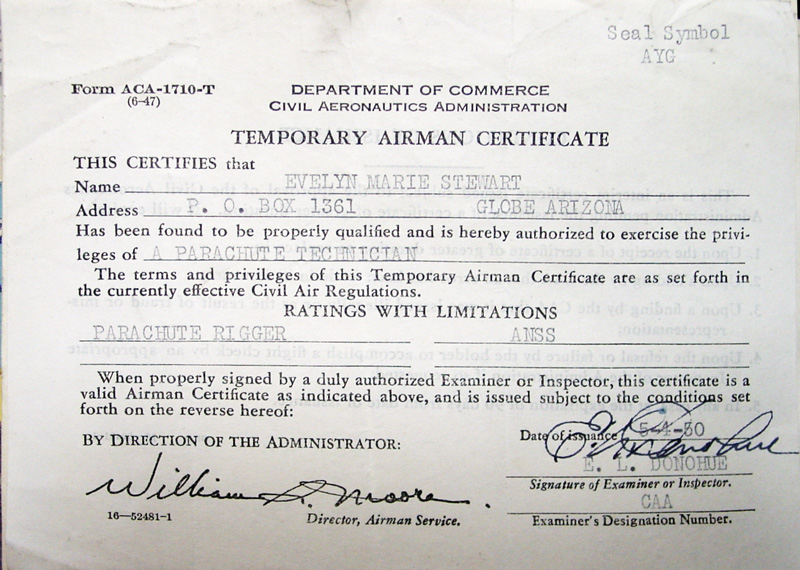
Always interested in flying, she signed up to be a part of the CPT program in Globe. After completing the program, she received her private pilot license. Evelyn also attended the Desert Parachute School in Phoenix, and received her rigger's license and for a time, was employed as a parachute packer at Arizona Gliding Academy at Wickenburg, Arizona.

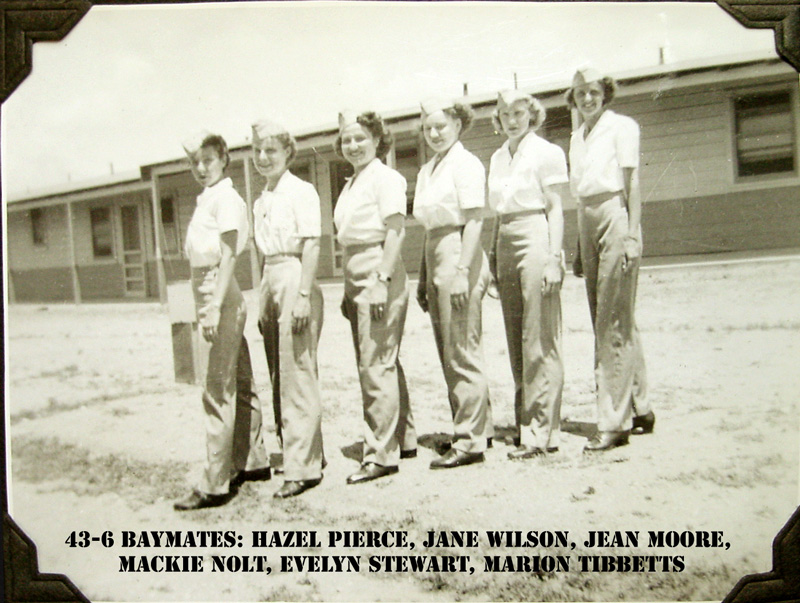
In 1943, she applied and was accepted for training into the WASP class of 43-W-6 and graduated, earning her silver wings October 9, 1943.

She was stationed at Enid Army Air Base, Enid, Oklahoma, a basic training base for Army Air Force cadets. At Enid, she flew basic trainers (BT-13, BT-15) as an engineering test and utility pilot.

After the WASP were deactivated, Evelyn married Frank Jackson, a ranch manager in Arizona. She enjoyed working with him and never lost her love of horses or the outdoors.

Evelyn continued to live in the home she shared with Frank after he passed away in 1984.

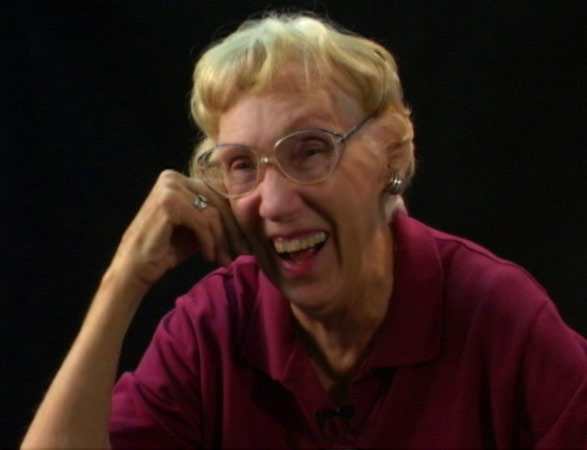
In November of 2001, Wings Across America traveled to Apache Junction, Arizona, where the City Manager loaned us her office in the Chamber of Commerce building. It was there we met and interviewed Evelyn, who, like many WASP, lived a private life, never boasting about her time serving her country. What a delightful experience it was to introduce the only WASP in town to the President of the Chamber of Commerce. All the city employees came out to meet Evelyn and shake her hand.

As the interview began, Evelyn gently opened the scrapbook filled with her memories of horses, flying, friends, parachutes and roundups. Even though she appeared almost frail, we soon learned of her aerobics, yoga, Tai Chi and her belly dancing classes.

On that special day in November, it was an honor to spend time with this lovely and quiet lady--and I don't think she would mind at all if I add--this lady pilot--this cowgirl.

submitted by Nancy Parrish, April 18, 2008

_______________

Evelyn passed away on April 15, 2008. Information on services will be posted as it becomes available.

___________________________

_________________________


Posted by Wings Across America--honoring and remembering the WASP

Tuesday, April 1, 2008

WASP ROSE ALICE PALMER, 44-W-6

In 1999, WASP Rose Palmer came to Waco, Texas to visit with her old baymate, WASP Anita Paul (AKA Sister Teresa). Even though they had not seen each other for over 50 years, it was as if time stood still. The young girls they used to be crept out in the whispers, the laughter and the friendship that could never grow old.

The next year, Rose came back to Waco, to the studios at Baylor Film & Digital Media for an interview with Wings Across America. Being on camera was not something she was used to, but, after a few minutes, she warmed up to the concept and to the opportunity to share her story.

From the Wings Across America interview with Rose Palmer:

Rose Alice Palmer was born in Fort Worth, Texas, September 30, 1921. She considered herself a tomboy, always tagging along after her older brother and his friends. Her father, who had been born enroute to America from Ireland, worked as a traveling salesman for Carson Perry Scott. When she was old enough, Rose would go along as his helper.

“I would go to town with him. He would go to the big stores in Ft Worth. If they wanted a product or whatever he had, then I would go back to the truck and get the samples and take them to him. Then at noon, he would give me my weekend allowance and I would stay downtown and go to the Worth Theatre. There were 3 big ones, the Worth, the Palace and the Hollywood. I would stay downtown then and go to the show and take the bus home.

I got a quarter for Saturday. That was a nickel for a Rockefeller hamburger, 10 cents for the show, and then it was only a nickel or a dime for the bus fare. That was Saturday’s and then I would get the other quarter for the week. So, I got 50 cents a week. But that was all you needed!”

Her most memorable teacher was Mrs. Noble, the math teacher. “When you took a test, she would write on the board, “First to thine own self be true,” and she’d leave the room. There would be no supervision at all, and nobody cheated! I don’t know of any student in the class that didn’t really respect and look up to her.”

Rose spent her freshman year of college at Texas Christian University as a Chemistry major, but in 1936, after her father was killed in an automobile accident, she began working in a book store to pay her tuition. Her sophomore year, she transferred to the University of Texas, where she could take classes in architecture and accounting.

After America entered World War II, Rose began working at an aircraft factory (later Lockheed Martin). She called it ”experimental engineering.” She was one of only 3 women engineers. As she described her primary job: “...just what was needed to get any problems that they were having designing the B24’s. They were having some problems with the tail turret, so that was our baby! I designed the tail gunner turret…the back of the plane. They were having trouble with it, and they assigned it to me to redesign it, which I did.”

Her first time in an airplane? “Oh, I loved it! I thought that was great…I gotta be doing this. I soloed and took to it quite readily. I really got the job to get money to pay for my time."

After being accepted into the WASP training program, class 44-W-6, Rose was assigned to her first flight instructor—a man she describes as “the mad Russian.” According to Rose, they didn’t get along. She finally had to tell him, “If you want to tell me something you can tell me without the expletives…without cussing. All you have to do is suggest it or tell me what you want. Don’t yell at me.”

After graduating and earning her silver WASP wings, Rose was sent to Courtland AAB, Alabama, but only stayed 2 weeks. Her next assignment was to Buckingham AAB in Florida—where she trained to fly tow target missions in the B-26 “Martin Marauder”. One of her fondest memories is when her brother came down from Orlando. “The tower called, we were taxiing out, but we hadn’t gotten on the taxi strips. I said, “Tell him to pull up in front of the tower there and hop aboard.” He said , “No thank you. Your brother does not desire to fly in a 26!” According to Rose, the B-26 was her favorite airplane.

After the WASP were deactivated, Rose flew several ferry trips to an airplane graveyard in Wickenburg, Arizona. She signed up for the USAF Reserves and reported to Carswell, where she ran the Link Training Department. Later, during Korea, she served as Assistant Adjutant at Carswell, eventually Assistant to the Chief of Personnel for the 8th Air Force—in Bangor, Maine.

In May of 1945, Rose went to work for Delta Airlines—and continued working for the company until she retired in 1983. At Delta, Rose's main job was as “OPERATIONS AGENT”—as she describes it: "Well, you met the planes, you figured the passengers…then you went by weight….the DC3s, you figured your loads, you got the mail, you got the passengers, you got the baggage. You figured how much gas they can carry, you dispatch the planes.”

This wonderful WASP was a kind, gentle soul, who believed she could do anything and did--but she did it quietly, no fuss --just hard work, determination and persistence. We are forever grateful to her for her kindness and still remember the sparkle in her eyes as she described flying—everything about flying. The other thing that made her sparkle? Her little black dog.

______________________

Written and submitted by Nancy Parrish, April 7, 2008. Information and quotes from Wings Across America interview with Rose Palmer, 2000

________________

From the Fort Worth Star Telegram:

Rose passed away on April 1, 2008, at a Fort Worth nursing home. She was a member of University Christian Church. She was preceded in death by her brother, Sam L. Palmer. Survivors: Her sister-in-law, Nancy Palmer; nephew, Jim Palmer; niece, Sally Palmer; great-nephew, David Palmer, all of Fort Worth; great-nephew, John Palmer Truelson of Boston, Mass.; and numerous cousins.
Wednesday, March 26, 2008

WASP Mary C. Wilson McConkey, 43-W-4


(flying) "It's like you've been allowed to enter a sacred, private world in which all the beauty is yours."

McCONKEY, Mary C. Wilson 87, of Springfield and formerly of Clifton passed away Wednesday evening, March 26, 2008 in the Eaglewood Care Center.

She was born February 24, 1921 in Springfield, the daughter of William H. and Mary Catherine (Dean) Wilson. Mary grew up on South Limestone Street in Springfield and as a young college student she worked and saved money so she could take flying lessons at the Springfield Airport.

Mary C. signed up to become a member of the WASP-Women Airforce Service Pilots, a program of the US Army Air Force.

She completed her flying training at Avenger Field in Sweetwater, Texas in February of 1943. Mary was one of the select groups of only 1,102 women to first fly American military aircraft. Mary and the WASP of World War II were true trailblazers. They flew every type of aircrafts on every type of mission except combat.

Mary C. was proud that she had contributed to the war effort by training pilots, flying surveillance and ferrying planes to strategic locations.

Her love of flying is captured by this quote she made in an article written about her in the Springfield News Sun in 1993: "It's like you've been allowed to enter a sacred, private world in which all the beauty is yours."

Mary was preceded in death by her loving husband, Wayne R. McConkey and sisters, Frances Wilson Fried Smith and Jane Wilson Austin Montgomery.

Over the past years, she has resided at the Eaglewood Care Center and been looked after by her nephew, John B. Fried of Columbus.

She will be sadly missed by John's family and her other nephews, Dean Wilson Fried of Columbus and Carl K. Fried of Florida; her dearly loved niece, Patti Austin Meyer and her family of Willoughby, Ohio.

A graveside service will be held on Saturday, March 29, 2008 at 1 p.m. in the Clifton Cemetery with Pastor Arby Conn officiating. Family is being served by the LITTLETON & RUE FUNERAL HOME. You may express condolences to the family.

Saturday, March 22, 2008

WASP ANN BAUMGARTNER CARL, 43-W-5


“Last time we spoke,” Wilber Wright said one day, “I asked what sort of a girl would want to fly experimental military aircraft. You didn’t say, “ he laughed."

“Well, I guess just a sort who, instead of religiously practicing the piano, had to go out and see what was happening in the woods that day, or down at the brook, or high on the hill. And then one day she saw an airplane fly by.”

Ann Carl, A WASP AMONG EAGLES
p. 83

_____________________

The following is reprinted from Ann's own words from WASP Betty Turner's "OUT OF THE BLUE AND INTO HISTORY:"

I was born Bugust 27, 1918, in the US Army Hospital, in Augusta, Georgia.

I graduated from Walnut Hill High School in Natick, Massachusetts, and from Smith College at Northampton in 1940. I was inspired to fly by a visit from Amelia Earhart to my grade school, an incident I would never forget. My father, an engineer and patent attorney, took me to the Newark Airport to watch the mail planes came in at night to watch Clarence Chamberlain train for his attempt to fly the Atlantic. I learned to fly in 1940 at Somersset Hills Airport at Basking Ridge, New Jersey. I soloed in eight hours and bought an old Piper Cub to build flying time.

I learned of the WASP organization while working as a writer for the New York Times. I reported for service in the WASP in January 1943 , at Howard Hughes Field, Houston Municipal Airport, in the class of 43-5. After graduation September 11, 1943 I was assigned to Camp Davis, North Carolina, flying and towing targets for artillery cadets to shoot at. From there, I was assigned to Wright Field Air Base in Dayton, Ohio, where experrimental testing of US and foreign military planes is done. Among the tests I flew were: air refueling using a B-24 as tanker and a P-38 as refueling aircraft; the first pressureized fighter cockpit in a special RP-47; tests flying a special P-38 where a cockpit replaced one engine turbo in order to test off-center flying in preparation for the twin-mustand P-82; weight and distance flying of the B-29 in preparation for the atom bomb mission to Japan; and evaluation flight of our first jest plane, the YP-59A fighter. I was the first woman to fly a jet for nearly 10 years. I also flew some British bombers and the German JU-88.

AFter deactivation, I married the designer of the P-82, Major William Carl, who later designed and built hydrofoil boats for the Navy and Grumman Aerospace. We have two children, one in England and one in Canada, Peter and Peggy. While the children were in school, I did flight instruction, performing insturment training for United Airlines, third pilots at Zahn's Airport on Long Island. My ratings included: private, commercial, instrument, multi-engine, flight instruction and instrument.

I was a jounalist specializing in science and the environment. I continued writing for Newsday and other publications. An avid sailor, my husband and I sailed the Atlantic twice and cruised the Mediterranean, the British Isles, and the French Canals. For the past 15 years we have resided in Kilmarnock, Virginia, where I have written a sailing book, The Small World of Long Distance Sailors, and a flying book, A WASP Amoung Eagles, about what it was like to be an experimental test pilot in WWII.

Links:

USAF MUSEUM FACT SHEET

FIRST FLIGHT SOCIETY ONLINE

Excerpt from Ann's Book--
PBS American Experience

_______________________

REPRINTED FROM TIME-DISPATCH

Ann G.B. Carl, first U.S. woman to fly jet, dies

Saturday, Mar 22, 2008

By KATHERINE CALOS
TIMES-DISPATCH STAFF WRITER

A school lecture by Amelia Earhart in 1932 inspired Ann Gilpin Baumgartner Carl to learn to fly. Like Earhart, she became an aviation pioneer. She was the first American woman to fly a jet airplane. While serving with the Women's Air Service Pilots (WASP) during World War II, she first flew the turbo-jet powered Bell JP-59A on Oct. 14, 1944.

During her wartime career as a test pilot at Wright Field in Ohio, she was the only woman test pilot flying World War II combat aircraft such as the P-38, P-47 and P-51.

She met Orville Wright and often found herself seated next to him at dinners, said her son, Peter Carl of Cambridge, England.

While flight testing the P-82 Twin Mustang, she met her husband-to-be, William P. Carl. They married on May 2, 1945, four days after the Allies claimed victory in Europe.

Mrs. Carl, 89, died Thursday in a Kilmarnock nursing home. Mr. Carl died Feb. 19.

Mrs. Carl's adventurous spirit continued after the family settled on Long Island, N.Y. She was a flying instructor and began a sailing career with her husband. After his retirement, they sailed the yawl "Audacious" across the Atlantic to cruise through Europe and return. They eventually settled in the Northern Neck of Virginia, from which they commuted yearly for 22 years by boat to Abaco Cay in the Bahamas.
Born at Fort Gordon in Augusta, Ga., in 1918 while her father served there during World War I, Mrs. Carl graduated from Smith College in 1939 with a pre-med degree. She had brief stints as a medical researcher, a dancer and a writer for The New York Times before realizing her ambition to fly.

She wrote about her military experiences in "A WASP Among Eagles: A Woman Military Test Pilot in World War II" and about her sailing life in "The Small World of Long Distance Sailors."

In addition to her son, she is survived by a daughter, Margaret "Peggy" Laufer, of Ontario, Canada, and three grandchildren.

Her memorial service will be Sunday at 3 p.m. at Grace Episcopal Church in Kilmarnock. Her cremains will be buried at sea with the cremains of her husband.

Monday, March 10, 2008

WASP RUTH STEELE WILSON, 44-W-5


RUTH STEEL WILSON, beloved wife, mother and grandmother passed away on March 10, 2008. She lived a great life for 88 years and leaves this world a better place.

Born Ruth Lorraine Steel in Bozeman, Montana to David A. and Kathleen Steel on December 12, 1919. Ruth was a woman of talent, beauty and brains. As a girl growing up in Chicago she had her own sailboat and taught sailing in Jackson Park Harbor. At the University of Chicago she excelled, participating in leadership activities and leading a Great Books discussion group.

After graduating from college, Ruth learned to fly and trained to be a WASP (*Women Airforce Service Pilots) in Sweetwater, Texas. *After graduation, she was stationed at Minter Field in Bakersfield, California, where she met *Army Air Force pilot James Sharp Wilson III, her husband of 63 years.

As a mother, Ruth was given the extraordinary challenge of raising five children including one with special needs. She not only accepted and met the challenge, but worked tirelessly for over 50 years with the Lake County Association for the Retarded (currently known as Arc BRIDGES) helping improve the quality of life for mentally handicapped children and adults and their families.

Throughout her busy life as a parent she somehow found time to pursue her own interests in sewing and writing (she penned a weekly column for the Gary Post-Tribune for several years). She loved sailing the family Snipe on Lake Michigan and countless north woods lakes of Wisconsin and Michigan. Canoeing, cross country skiing and taking photographs were also passions of hers.

As the family chronologist, she created photo albums telling the story of many years of activities and adventures including numerous trips in the family airplane.

When her children were grown and moved away, she wanted to learn more about the financial world so she spent several years working for a tax firm, an insurance company and a real estate brokerage. She also enjoyed investing in stocks, bonds and real estate. She loved to travel in the Midwest and found great pleasure and satisfaction in everyday life.

Miller Beach and the Dunes were home. The gardens, birds and landscapes, the seasons and the people were dear to her heart.

Ruth was preceded in death by her parents and her sister Ann Anderson. She leaves behind her husband, local watercolor artist Jim Wilson; her children Tracy (and her husband Andy Nelson) of La Jolla, California; Jim (and his wife Janice) of Plainwell, Michigan; Chuck (and his wife Becky) of Newport, Rhode Island; Scott Wilson of Merrillville, Indiana and Kim (and his wife Jan) of Lac du Flambeau, Wisconsin. She also leaves seven grandchildren Drew, Tim and Gray Nelson, Jayne, Jimmy, Sally and Maggie Wilson. Ruth will be deeply missed.

A Memorial Service will be held at 12:00 noon on Saturday, March 15, 2008 at the Marquette Park United Methodist Church, 215 N. Grand Boulevard in Miller.

In lieu of flowers, memorial donations may be made to Arc BRIDGES, 2650 W. 35th Ave., Gary, IN 46408, phone number (219) 985-6562. Burns Funeral Home, Hobart in charge of arrangements. www.burnsfuneral.com

Published in the Post-Tribune from 3/12/2008 - 3/14/2008.

(*edited for accuracy by np)

Friday, February 22, 2008

WASP ISABEL MADISON VAN LOM, 43-W-4


IN HER OWN WORDS from Betty Turner's "Out of the Blue and Into History"

"I was born on November 8, 1917, on a farm near Crystal City, Missouri. While living in Crystal City and working as a stenographer, was attracted to the air when some men in town purchased a Piper Cub and arranged for an instructor from nearby St. Louis to give lessons.

In March of 1941, I had my first lesson and continued flying, earning my private and commercial licenses.

I was accepted in the Women's Flying Training Detachment program on February 15, 1943, at Houston, Texas, and was graduated from the program at Sweetwater, Texas on August 7, 1943, in class 43-4 as a WASP.

Was assigned to Air Transport Command (ATC) and reported to the 5th Ferrying Group, Love Field, Dallas, Texas, where I remained until the WASP were deactivated on December 29, 1944. I flew single engine trainer planes and twin-engine utility planes, the P-39, P-40, P-47, P-51, P-63, and checked out as first pilot in the B-25 and C-47 (the cargo version of the DC-3.)

After deactivation, I earned my instructor rating and instructed at Stephens College in Columbia, Missouri, and on a program at Oregon State College in Corvallis, Oregon, where I met my husband, Gerald Van Lom.

We were married in 1949, and lived in Portland, Oregon, and later moved to the Beaverton, Oregon area with our five children, William, Christine, Richard, Gretchen and Charles.

In Beaverton, I worked for Tektronix, Inc., an electronic firm, and retired after 18 years as a contract administrator for the service department.

I have been a volunteer in the emergency service department at St. Vincent de Paul in Portland.

________

Like so many WASP, Isabel gave back to her community and made a difference in her world.

_______

Isabel passed away at Providence St. Vincent's Hospital on Feb. 22, 2008 at age 90.

A memorial Mass will be said at St. Cecilia Catholic Church, 5th and Franklin Street, Beaverton, at 11 a.m. Wednesday, Feb. 27. Recitation of the holy rosary precedes the Mass at 10:30 a.m. In lieu of flowers, the family suggests remembrances to the charity of your choice.

Isabel is survived by her children: Christine Florendo, Juneau, Alaska; William M. Van Lom, Portland; Richard G. Van Lom, Peoria, Ariz.; and Gretchen Van Lom, Seattle; three grandchildren and one great-grandchild. Isabel's son, Charles E. Van Lom, preceded her in death in 1995 and her husband, Gerald, in 1998.