Saturday, July 13, 2013

Betty Jo Streff Reed, 44-W-7 June 22, 2013

“Never let go of your dreams.  If you have a dream, there’s no reason it can’t be fulfilled, you’ll find a way.  It’s possible, because I didn’t have much...I was a poor student and managed to fulfill my dream.  I wanted it so bad, I found a way. 
 Flying was freedom and I loved flying.”
                                                        /s/Betty Jo Reed


June 22, 2013, just two days after her ninetieth  birthday, WASP Betty Jo Streff Reed slipped away and took her final flight. 

Betty Jo was born June 20, 1923 in Sherman, Texas to John Nicholas Streff and Nellie Ruth Dilworth Streff.  Her father was a general contractor and supervisor for the Georgia Marble Company, where his work created opportunities for the young family to travel. After Betty Jo was born, the family moved from Texas to Oklahoma City and, eventually, settled outside Chicago, Illinois.

Betty Jo's life-long love of flying began when her dad shared his own love of aviation by taking the family to airshows, sometimes in a farmer's field, to watch the early barnstormers.   She remembered the planes flying by upside down and watching the wing walkers and the parachutists. 

She remembered sitting in her dad's lap at age four,  as he would read her news of Charles Lindbergh and his trip across the ocean.  From then on, every time she would hear an airplane fly over the house, she would run outside and yell,  “Hi, Lindbergh!”   

When she was six, Betty Jo's father paid $1 for her first flight in a Ford tri-motor at the Curtis-Reynolds Airport air show in Chicago.  As she later recalled, it was 'love at first flight:'    "I remember feeling free and happy and loving the whole experience.  From that point on, I knew that I wanted to fly.”

A few years later, she skipped school to watch the airplanes.  She took her bike and, instead of turning left to go to the junior high school, she turned right-- and rode nine miles out to the airport.  She spent the day standing near the runway, watching the planes take off and land.  Even though she never did it again, the memory lasted a lifetime.

Thoughout her schooling, Betty Jo struggled with an undiagnosed learning disability.  However, by the time she entered high school, she found a way to overcome every challenge with hard work, determination and a curiosity to know ‘why.‘   She became a pitcher on the girls baseball team-- a team so good, they beat the boys team.   In high school, she had a talent for art and soccer, showing up after school to play with the boys.  

When America entered World War II, Betty Jo put her plans for attending the Chicago Art Institute on hold, because so many of the instructors had signed up for military service.  She went to work for Marshal Fields and began taking flying lessons so that she could ‘do her part.’  It took half a week’s salary to pay for one hour of flight instruction with instructor Willie Clark.  Her first lesson was in a J3 Cub-- on skis.  

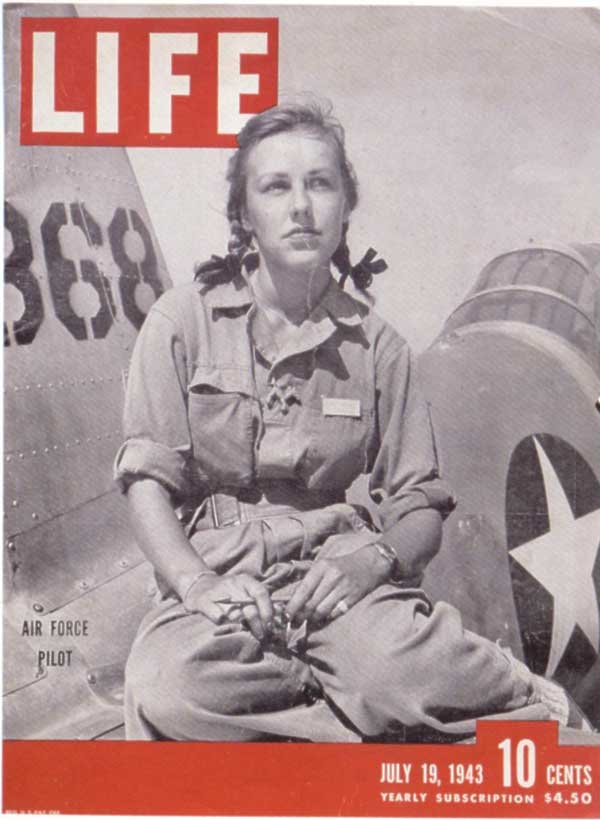
In 1943, she was hired by Douglas Aircraft and went to work in the tooling department. Eventually, she was promoted to cockpit installation.  While at Douglas, she saw a Life Magazine with a girl pilot on the cover.  When she read the article about WASP training program, she was thrilled and ready to sign up.

Because Betty Jo’s job at Douglas was considered ‘essential’ for the war effort, she had to get special permission to even apply for the training program.  After permission was granted, she was interviewed, passed all the required tests and was accepted for training as one of the ninety-eight women pilots in class 44-W-7.  

She paid her way to Sweetwater, Texas and arrived during one of the coldest winters in West Texas history.    Betty Jo described herself as “tall and skinny,” when she entered training.  On that  first awkward day at Avenger Field, one of her classmates affectionately gave her the nickname,  ‘Birdlegs.’  That nickname and the instant, comfortable friendship with her classmates stayed with her throughout her life.

On September 8, 1944, after seven months of training, Betty Jo and fifty-eight of her classmates graduated and received their silver WASP wings.   She received Army orders to report to the Eastern Training Command, Columbus Army Air Field, Columbus, Mississippi, where she flew Beechcraft AT-10’s and BT-13’s as an engineering test pilot, ferry pilot and administrative pilot.    

On Dec. 20, 1944, when the WASP were disbanded, Betty Jo paid her way back home and returned to a job at the Douglas C-54 plant as a test pilot.  
When an automobile accident temporarily grounded her, Betty Jo married Carl W. Reed.  They were blessed with two  boys and two girls.  

In 1957, the young couple opened the first McDonald’s franchise in Colorado--which was the third McDonald’s restaurant in the U.S.  A year after the birth of their fourth child, Betty Jo began flying again.  She earned her rating to fly Lear Jets and the King Air.   As their family business grew to ten McDonald’s,  eventually, she became a corporate pilot.  

Betty Jo competed in six Power Puff Derbies, winning a “Best in Class” from Flying Magazine.  She was a member of The Ninety-Nines, Inc., The Arizona Wing of the Commemorative Air Force, WMA (Women  Military Aviators) and the Air Force Association.   She served as President of the Phoenix Wing of the American Aviation Historical Society and was a docent at the Champlin Fighter Aircraft Museum in Mesa, Arizona.

In 1999, Betty Jo was inducted into the International Forest of Friendship and in 2010, she and her sister WASP were awarded the Congressional Gold Medal, the highest civilian honor Congress can bestow, for their pioneering military service during World War II.

Betty Jo is survived by daughters Melissa Reed of Aurora, Colorado and Sally Reed of Dallas, Texas; son John Reed of Deer Lodge, Montana; three grandchildren and one great-grandchild.  Her husband Carl Reed, son, Guy Reed, and two sisters preceded her in death.

A memorial service was held on Saturday, June 29th at 10:00 AM at St. Luke's Episcopal Church, 1270 Poplar Street, Denver CO 80220. 


 Respectfully posted by Nancy Parrish


sources:
Wings Across America’s Interview with Betty Jo Reed, Nov. 12, 2001
“Out of the Blue and Into History” by WASP Betty Turner  pp 465, 466
US Air Force News:   1/16/2006   
Denver Post, June 30, 2013


Personal note:

I met Betty Jo Reed for the first time in November of 2001, when mom & I traveled to Arizona to interview WASP for our Wings Across America project.  Betty Jo had agreed to meet us at one of her favorite places, the Champlin Fighter Aircraft Museum.  She was almost more excited about showing us all the wonderful airplanes than she was in talking about her life.  She was kind and so generous with her time, never complaining that we continued talking through lunch and into the afternoon.  In fact, we rolled tape until the museum staff had to lock the building up.  It was a delightful interview.

Betty Jo was a WASP who traveled to every WASP convention, the huge airshow at Oshkosh, to the Frontiers of Flight Museum when the WASP were honored on Veteran’s Day, 2009 and to Washington, DC  when the WASP were awarded the Congressional Gold Medal.   She was always upbeat, despite the health challenges and the battles to survive over the last few years.  She never gave up and always lifted those who were concerned for her. 

In September of 2012, Betty Jo called to see “what was going on.”  We chatted for a few minutes and then I asked her how she was.  That is when she shared that she was ‘not doing good,” and then immediately changed the subject to ask how mom and I were doing.  

Her question was so typical of this sweet lady, who has touched so many with her courage and her cheerful spirit. She spent only a moment on herself and then she asked how we were.  When I asked a few more questions, she shared her sad news about her fight with a second, much more deadly cancer than the one she successfully battled not long ago.  
During our interview in 2001, we asked Betty Jo, other than her family, what was the one thing she was most proud of?   Her reply:  “I’m most proud of my flying accomplishments.  I think that if you were to talk to some of the men that I flew with as a corporate pilot, they were surprised and proud.  In fact, they had bets on how long I’d last.  It made me proud of what I was doing.  I hand’t been very proud in my schooling--didn’t have much else to measure other than that.  I was very proud of my ability to fly.”
It was an honor to know Betty Jo...to laugh with her and listen to her stories.  She will be missed by all of us whose lives were touched by her gentle and encouraging spirit.  God bless you all.

Nancy 


Friday, July 12, 2013

Barbara Jane 'BJ' Erickson London, WAFS July 7, 2013


"I was born at the right place at the right time, and for my part,
it was a fantastic experience.  I think I was lucky.
I probably was in the best spot I could possibly have been.
The Good Lord took care of me all the time I was there
and I got through it all right and my life has gone on from there.  

I think it was a tremendous opoprutunity
that I was given and I'm thankful for it."  *
/s/ Barbara London, WAFS


Barbara Jane 'BJ' Erickson London, WAFS  
July 1, 1920   -  July 7, 2013

London operated an aircraft sales business at Long Beach Airport
Posted:   07/10/2013 03:41:56 PM PDT
Updated:   07/10/2013 03:42:03 PM PDT

Barbara Erickson London, a pioneering female pilot who helped put Long Beach on the aviation map, died July 7 in Los Gatos. She was 93.

Erickson, who lived most of her life in Long Beach and operated an aircraft sales business at Long Beach Airport, had moved to Los Gatos to be close to her sister.

"She has been surrounded by family and friends and the one thing she wanted was to be able to stay in her own home, be in her own bed, and be with the people she loved," her daughter, Kristy Ardizzone, said. "All that happened just the way she wanted and she passed with dignity and grace surrounded by lots of love."

In 1940, London (then Erickson) became the first woman to be recruited into the Civil Air Patrol program at Long Beach's Daugherty Field. During World War II, she was appointed as Squadron Commander for the 6th Ferry Command.

The young pilot was qualified to fly all pursuit planes, the medium-size bombers A-20, A-26 and B-25, the cargo craft DC-3 and C-54 and the mighty B-17 Flying Fortress bomber.

Among her wartime feats in the ferrying service was flying four 2,000-mile trips in five days. She was the only woman during the war to be awarded the Air Medal for her service.
In 1948, she was commissioned as a major in the Air Force Reserve.

The  Woman's Airforce Service Pilots (WASPS) was disbanded at the end of 1944 after complaints from male pilots that women were taking flights and jobs. In 1971, Congress passed legislation to give veteran status to WASP fliers, and in 2010, President Obama awarded Congressional Gold Medals to surviving WASPs, including London.

"She was so thrilled that all the gals finally got their acknowledgment when they received the Congressional Medal," Ardizzone said. "It was all about them."

Barbara met her husband, Jack London Jr., during the war when they were both pilots. After their marriage, they operated United States Aviation, a flight school, until the Korean War. He preceded her in death by 40 years and one day.

London would go on to found and operate Barney Frazier Aircraft, Inc., in Long Beach with her younger daughter, Ardizzone. Her older daughter, Terry London Rinehart, is a commercial pilot.
London also was active in the Powder Puff Derby, an airplane race series for female pilots. She served as secretary of the organization and raced herself for a number of years.

In 2006, a street near the airport was named Barbara London Drive, and she served as both an official and unofficial community advocate for the Long Beach Airport for years. She figures prominently in the airport's history exhibits along with other great Long Beach-based female pilots, including Gladys O'Donnell and Kay Daugherty.

There will not be a formal memorial or service, following her wishes, Ardizzone said.
"She just wanted people to know how much she loved being a part of the Long Beach community and especially the LB airport," Ardizzone said. "She was such an amazing mentor and supporter and touched so many people's lives."

Staff writers Harry Saltzgaver and Tim Grobaty contributed to this report.
____

v/r article respectfully reposted by Wings Across America as written

*additional quote from "Forgotten Wings: An Oral History of Women Airforce Service Pilots, the WASPs" Copyright 1992:  Gail Gutierrez and  Oral History Program California State University, Fullerton
Photo added by Wings Across America

Articles:

Wednesday, May 22, 2013

V. Scotty Bradley Gough, 44-W-7 | May 22, 2013

"Don’t ever put limits on your dreams.   Dream farther and higher than you can imagine.   I would never have flown if I hadn’t looked to the sky and beyond." 
/s/ Scotty Bradley Gough, 44-7


Scotty Bradley was born on October 28, 1922 in Los Angeles, California.  She lost her mother at an early age, so she and her two brothers were raised by their dad. 

From the time she could remember, she said she wanted to fly.  Even before she was old enough to take lessons, she read everything she could on flying.  When she realized that pilots had to have good eyesight, she began eating carrots, one each day, which she did for the rest of her life. 

After high school graduation,  she was chosen as one of ten finalists for a college scholarship. When interviewed, she was asked what she wanted to be,  and what courses she would take.  When she told the committe she wanted to be a pilot and take aeronautical engineering courses, the looks on their faces convinced her the scholarship was not going to happen.  So, she began working in a bank, earning $25 a week.  Her dad encouraged her to take part of her salary and follow her dream.  She did.

Scotty began taking ground school and flying lessons at Glendale Municipal Airport in Glendale, California.  It was after she had soloed and on an early  Sunday morning (December 7, 1941), while practicing landings,  that she was given a red light signal.  When she taxied to the hangar, she learned that Pearl Harbor had been attacked.  America was at war.   Immediately, all civilian flying within 200 miles of the coast was grounded.

In order to be able to continue flying, she commuted inland to Blythe, California, whose municipal airport was beyond the restricted coast line 'no-fly'  zone.   There she worked on the weekends with an ambulance corps that was teaching women to fly.  Once the Blythe Army Air Field became operational,  Scotty relocated closer to the base and worked in the base's control tower.  However,  she also continued to build up her flying time.

When Scotty heard about the WASP training program, she wrote to Jackie Cochran, the originator of the program and its director.  The reply was disappointing.  She was told that, although she had all the basic requirements,  she wasn’t old enough.  She then knew that she would have to wait a year before reapplying.

During that year, the owner of the local airport offered her free flying time if she would make parachute jumps, which would attract people to the airport.  Her instructions for her first jump came from the parachute rigger:  “When you jump out that door, you count to ten real slow, because I don’t want that parachute caught in the tail and ripped up.”   She made her first jump and continued jumping and building up her flying time until she was old enough to report to Avenger Field for WASP training.

Scotty paid her way to Sweetwater, Texas and, on February 11, 1944,  reported for training (together with ninety-seven other hopeful young women pilots) as a member of Class 44-W-7.    She was immediately chosen Squadron Commander.  This ‘honor’ meant she was responsible for marching the trainees everywhere, was last in line for the mess hall, and the first one out the door each morning in order to line up her classmates to march to their destination, be it the mess hall, flight line,  ground school, or calisthenics.    

For the next seven months, she went through the Army Air Force’s training program, taking the same type classes and flying the same type airplanes as the AAF cadets were flying.   On September 8, 1944, Scotty and fifty-eight of her classmates graduated.  One final time, Scotty lined them up,  and they proudly marched onto the stage to receive their silver WASP wings.

After graduating,  she received her Army Air Force orders to  report to Williams Army Air Field in Mesa, Arizona, which was under the command of the West Coast Training Center.  While there, she was assigned to fly ferry missions in AT-6‘s.  She also flew as an engineering test pilot, making sure that damaged or red-lined planes had been repaired and were safe for the cadets and instructors to fly. 

When the WASP were deactivated, she returned to California and flew sighteeing flights around southern California.  Eventually, she joined other WASP as part of a ferrying service, flying planes to civilian factories around the country and back to California.

In November of 1947, Scotty married Peter Gough, the brother of classmate Joan Frost Gough.  She continued flying until the young couple started their family.    Her last commercial flight as a pilot was the day Idlewild Airport became John F. Kennedy Airport.  Although she was seven months pregnant at the time, Scotty flew a Luscome as part of the opening day ceremonies.   With the arrival of each of their children:  Michael, Joan-Scott, Larry,  and Connie, she was a dedicated, full-time mom. 

For many years, she shared her story as a WASP by traveling to Oshkosh, Wisconsin and speaking at EAA’s Air Venture. She was also a tireless volunteer in the WASP Stores at Oshkosh and at other air shows across the country. She was a frequent speaker at local events and schools and helped establish a WASP exhibit at the Air Mobility Command Museum at Dover Air Base. 

In 2002, she was inducted into the 99‘s “Forest of Friendship,” and in 2007, she was inducted into the "Delaware Aviation Hall of Fame".  She was a life member of the First Flight Society at Kitty Hawk and an Honorary Commander at Dover Air Base in Delaware.  

How did Scotty feel about being a WASP?

 I want you to know that all of us were just -- some people asked us, you know, why we did this-- why we flew.   It was an honor and a privilege for us to serve our country, doing what we loved best, and that was to fly. But to tell you the truth, and every WASP will agree with me on this:  if I had had the money at that time, I would have gladly paid them for that wonderful training and the opportunity to fly those wonderful airplanes.”

In 2010, Scotty and her sister WASP were awarded the Congressional Gold Medal for their outstanding service to our country during World War II.  At the ceremony, which was held in the Emancipation Hall of the United States Capitol, she was seated on the front row.

Scotty never lost her love of flying or of parachute jumping.  Always an outstanding athlete, she eventuallly added golf, tennis, bowling, gardening and cards to her passions, along with enthusiastically 'rooting' for her favorite team: the Maryland Terrapins.  She loved living near the beach, where she spent time walking and swimming.  Her many acts of kindness she kept to herself, but her family is just now beginning to learn the depth of her compassionate, loving spirit.  

On May 22, Scotty quietly slipped away. Her two daughters were at her bedside.   Her latest hospital stay and battle with pneumonia had weakened her to the point that,  when she developed a bacterial infection, she wasn't able to overcome it.  Her one wish was to go back home, which she was able to do on May 21st.  Her family later learned that the day she died was also the birthday of her younger brother, who had been deceased for several years.  

Scotty took her final flight  moments before a terrible rain storm arrived.  Her family is sure  she wanted to get beyond the clouds before they came in, as they lovingly  expressed it:  "She'd always look at the clouds and say how beautiful they were,  but she wouldn't want to be flying through them.”    
“What we'll all remember and miss about mom was her ever present smile, her constant wave and greeting of:   "Hello,  Love",  and her usual farewell of:   "God Bless."

Scotty was preceeded in death by her husband, Peter W. Gough and her younger brother, William Bradley.  She is survived by her children Michael Peter Gough, Joan-Scott Gough, Laurence Bradley Gough and Constance Josephine Gough.  One grandchild, Heather Foster, USAF MD, is currently a flight doctor in Afghanistan.  She is also survived by her older brother Laurence Bradley and sisters-in-law Joan Bradley and Pat Gough, along with numerous nieces and nephews.

A memorial mass to celebrate Scotty's life will be held at St. Ann's Catholic Church in Bethany Beach, Delaware on June 25, 2013.


Personal note:

I first met Scotty at Oshkosh, where I was immediately captivated by her sweet spirit and gentle encouragement.  Her ‘Hello Love’ and ‘God bless you’ were always a part of every conversation.  Those words echo today, as I see her smiling face and sparkling eyes-- 20/20 vision from all those carrots! 

Until her health prevented her, she was at every WASP function, including the opening of the Fly Girls Exhibit at the Women’s Memorial in 2008 and the Congressional Gold Medal Ceremony in 2010.  On both occasions, I still remember her sitting smack dab in the center of  the front row!   Scotty, as always, was smiling.  


Scotty at the CAF Air Show.  In the background, her photo in her
WASP uniform, 1944, although she wasn't a fan of the beret.

My life has been  touched by the incredible women who have gone before--like Scotty -- by their passion and their invincible spirits--by their kindness and their encouragement.  Over the last few years, Scotty and I shared a passion for women’s basketball and for the Baylor Lady Bears.  She would call,  or I would call,  or her daughter, Joan,  would call,  and we would all be cheering.  I will miss those days, but I will never forget.

Scotty Gough was more than a WASP to me.  She was a friend.  

God bless her family and all who have been touched by this special lady.  We are all blessed for having known her.

Respectfully posted by Nancy Parrish

Sources:
Betty Turner’s “Out of the Blue and Into History”
Veteran’s History Project interview with V. Scotty Gough


Wednesday, May 15, 2013

Marguerite "Sis" Tuffin Bernhardt, 44-W-3 | May 15, 2013

“We all did what they asked us to do… We were just happy doing what we were doing. It was a rarity. We were thrilled to be a part of it.   It was our war, our country and we were able to help.”  /s/Marguerite Sis Tuffin Bernhardt, 44-W-3


WASP Marguerite Tuffin Bernhardt was born in Hartford,  Connecticut on May 27, 1919 to a bookkeeper dad and part-time schoolteacher mom.  She fell in love with flying as a young girl.  At age thirteen, she built her first model airplane with balsa wood, glue,  and tissue paper. 
At age sixteen , Marguerite  applied for a ground school program for boys who wanted to learn how to fly.  Although the school didn’t actually teach flying, her classes were in Physics Of Flight, Navigation and Airplane Engines.  She was the only girl in a class of thirty.  When asked how the boys felt about having a female classmate, she later said, "Some of the boys didn't take to it, but I didn't care.  The course was three or four months,  and only two boys and I finished it."
After graduating from high school, Marguerite worked as a clerk with an insurance company and, every two weeks, she was able to take one week’s salary and pay for a flying lesson. "I didn't always get my lesson. They would take men first. So I’d say, 'OK, I'll wait’,  but just doing it, just being up there. I wasn't disappointed."
In order to keep flying and learn more about airplanes, Marguerite took a job working on airplane electrical systems at Bradley Field, Connecticut. While there, her mother told her about the military training program for women pilots.   She applied and, after completing the personal interview, tests,  and Army physical, she was accepted as a member of class 44-W-3.
Marguerite  paid her way from Conneticut to Sweetwater, Texas,  which was not an easy trip during World War II.   Of the 100 young women pilots who entered her training class, she was one of only fifty-seven who graduated.  On April 14, 1944, Marguerite proudly donned her Santiago Blue uniform and received her silver WASP wings.
After graduation, she was assigned to Perrin Army Air Base in Sherman, Texas, where she flew AT-6’s, AT-17’s and BT-13’s.  While at Perrin, she was given a temporary assignment to Bryan Army Air Base in Bryan, Texas. 
While stationed at Bryan, Marguerite completed Instrument Instructor’s School and received her Green Instrument Card, qualifying her to instruct on instruments and to make decisions about fly/don’t fly when the weather called for instrument flying.  She instructed Army Air Force cadets in instrument flying until the WASP were disbanded on December 20, 1944. 
She then returned to her home in Connecticut and married.  Eventually,  the couple had one son, Robin.   
Marguerite was living in the Ocala, Florida area when the news about the WASP being awarded the Congressional Gold Medal, the highest honour our nation can award a civilian, was first released.   Although she was not able to travel to Washington, she instantly became a local celebrity with the aviation community and the local newspapers.  In May, 2010, she was awarded her replica Congressional Gold Medal by Congressman Cliff Stearns.
Over the last several years, Marguerite found joy in attending local air shows and other aviation related events, making new friends and sharing her story with a new generation of Americans.   
Friend Connie McConnell shared her thoughts about Marguerite
       “What a privilege to know such a wonderful lady.   My husband said she was the best of the best. She was just one of a kind. She was feisty and strong-willed, but she was the most gentle person that you would ever know, and always gracious about everything,"

Marguerite recently told her friend that, with the exception of the birth of her son, being part of the WASP was the best experience of her life.  Because of this patriotic American and her WASP peers, today  women are flying as military pilots in every uniformed service. 
  

Marguerite Bernhardt took her last flight on May 15, in Ocala, FLorida at Hospice of Marion County’s Estelle’s House.   She was ninety-three.

She is survived by her brother,  George Tuffin;  granddaughter, Renate Bernhardt;  and great granddaughters Kiley and McKenzie. She was preceded in death by her only son, Robin.

A military memorial service will be held June 12, 2013 at the Florida National Cemetery.

God bless this American patriot and trailblazer and all of those whose lives she touched.

Respectfully posted by Nancy Parrish

Resources:
Ocala Star Banner    March9,2010   
Ocala Star Banner, March 28, 2010


Friday, May 3, 2013

Dori Marland Martin, 43-W-8 | April 22, 2013


“I wanted to do something in the war.  I didn’t know what, but I wanted to do something...because all of my boyfriends, everybody I knew was doing something.   I didn’t just want to sit home and model or be an actress.    I tried to donate blood, and they said, ‘Well, you’re not old enough’.   Then my father told me about the WASP , and I thought, “Well, that’s perfect.  That would be perfect.  I had several boyfriends who were airline Captains.  I had excellent instruction!”

 WASP Dori Marland Martin, who traded her career as a Hollywood actress to fly for her country as a WASP, has flown her last mission. On April 22, 2013, she turned her face to the sun, smiled, and quietly slipped away.   
____
 She was born Dori Marie Jugle in Philadelphia, Pennsylvania on November 14, 1921 to Richard Marland Jugel, President of ABCO Ball Mill (a mining machinery company) and his wife, Marie Henkel Jugle.    Dori never stayed longer than two years in one school, as the family traveled back and forth from Pennsylvania to Colorado.  Between elementary and high school, she skipped three grades. Not wanting her to graduate too early, school officials suggested she be kept out of school each time she was advanced a grade.  
During her time off, Dori fell in love with horses and, at age fourteen, she became a champion rider on her horse, ‘Firebird’.  She rode in the hunting, jumping, bareback and English categories, and was  Colorado State Champion  for the ‘under eighteen’ category  for three years in a row.   Eventually, the family moved to Chicago, where Dori spent her last two years of high school,  swimming with the Lake Shore A.C. Water Ballet Team.  
After high school graduation, in August of 1940, Dori won the Catalina Swim Suits  national competition for the “Most Beautiful Figure.”  The prize included a trip to California, where she enrolled as a full time student at the Pasadena Playhouse.  She took her father’s middle name as her official stage name and became Dori Marland.   She spent two years learning the craft of acting  and working at Paramount Pictures.  During her time off,  she taught riding.  
After America was attacked at Pearl Harbor, Dori wanted to do something to help the war effort.  Like many other Hollywood starlets,  she agreed to pose for a 'pin-up picture' as a morale booster for the troops.  However, she was desperate to do more.   Her father told her about a training program for women pilots to fly for the Army Air Forces.  She immediately returned to Denver and began taking flying lessons from two boyfriends, both Captains with Continental Air Lines.  After soloing in a Luscomb, she continued building up her hours.  Once she met the requirements, she applied for the WASP training program, was interviewed in Denver,  and was accepted.   
She reported to Avenger Field, Sweetwater, Texas right after the Fourth of July in 1943 as a member of class 43-W-8.  After completing six months of flight training, Dori and 48 of her classmates graduated in the first ceremony held inside the new gymnasium at Avenger Field.  It was also the first time that graduates sat on the stage.  Although no band played and there was no ‘pass in review’, the graduates were the first class of WASP to wear the newly designed official Women Airforce Service Pilots silver wings.  
After graduation, Dori was sent to Douglas Army Air Field, Arizona,  the largest twin engine advanced training base in the United States.  Her jobs included engineering testing and,  as she later described it,  “going places and bringing planes,  that were wrecked or just barely making it,  back to Douglas to be repaired,  and administrative flying--flying Generals around who want to see things.” 
While at Douglas, she was sent on temporary assignment to Orlando, Florida, where she completed the officer’s training program.  Eventually, she was transferred from Douglas to Kingman, Arizona.  There, she completed the B-26 transition training and flew tow target missions for air-to-air gunnery practice.  Her last duty station was Luke Field, Arizona, where she flew single engine trainers.
After the WASP were disbanded, Dori returned to Denver and took a job modeling designer fashions.  On New Year’s Eve, she met Colonel Herbert Morgan, WWII Flying Tiger Ace, former Aide to General Chenault and the Commanding Officer at Casper, Wyoming AAB.   They were married in the Lowry AFB Chapel in Denver, Colorado in June of 1945.  Eventually, her husband became Commanding Officer at Clovis Army Air Base, New Mexico, which was the largest B-29 Operational Training Unit in the United States.  From Clovis, her husband was transferred to the Pentagon, so they moved to Washington. 
Shortly afterwards, Dori returned to Denver, ending her marriage.  She then began touring with an acting company, performing at air bases in the Rocky Mountain Region.   
“I played the ingénue,  of course.  And one night, one of the key characters didn’t show up (one of the older ladies), so I took that part.  And I had an old wig and the wrinkles on my face, and I was just horrified.  Nobody looked at me.  Nobody said ‘hello’.  None of the boys paid any attention to me.  I just was really horrified, so I never played her again!  From there on, I stuck with the ingénue.”
Eventually, she moved back to  California, where she took a modelling job at I. Magnin & Co., which included modelling hats for the artists to draw for magazine ads. 
Dori's  father encouraged her to continue flying and,  in 1947,  friend Jo Stafford asked her to pilot her plane in the Cleveland Air Races.   She agreed and entered the race.  She was in the lead when the plane had engine problems and eventually quit at tree top level.   Dori survived the crash, but never raced again.   
Shortly after the race, Dori married Johnny F. Martin, Chief Test Pilot for Douglas Aircraft.  The couple moved to Muroc, California in the Mojave Desert,  where the Muroc  Dry Lake (now Edwards Air Force Base) was used for flight testing.  Eventually, they moved to Beverly Hills where they enjoyed the Hollywood life style.  The Martins built a home in Rolling Hills and started their family.   Dori became a stay-at-home mom, den mother,  and little league cheerleader for her  two young sons, Richard Joseph and Michael James.  
Eventually, she completed night school courses and earned her real estate license.  She then went to work for Wagenseller & Durst Securities Corporation,  managing high-rise office buildings in downtown LA.    When the couple  separated,  Dori and her sons moved to South Pasadena.  
After a fall, a long rehab ended Dori’s career in real estate management.  She called it the toughest time in her life--  caring for her parents, her sons and, as she described it,  she was “very, very broke.”  She pulled herself up by her bootstraps and worked her way back by working the graveyard shift at the US Post Office, sorting mail.   As she later remembered, “I’d eat lunch at three o’clock in the morning in my car in the rain.  I got through it.“ It took her six years.
 Later in her life, she began traveling, spending time with friends in Europe and the US.   On a short visit to Sun City West, Arizona, she decided to stay for a while--which turned into twenty-seven years.  Just a quick bus trip to Las Vegas, Dori loved the area, and continued to ‘enjoy the ride,’ entering and winning blackjack tournaments,  making new friends, and swimming year round. 
In 2001, Wings Across America was privileged to interview Dori at her home in Arizona.  She was a charming, warm, beautiful lady.  During the interview, when  asked what her favorite airplane was, she didn’t hesitate. 
“The B-26.  Some of the men didn’t want to fly it.  They wouldn’t fly it, but I loved it!   The reason I loved it is because it was a real airplane.  You had to fly it.  You couldn’t just sit there like somebody’s grandmother,.... The B-26 was a wonderful plane.”
Just after her service as a WASP, Dori agreed to pose for a picture.  It is fitting to include it here.  
When asked what her favorite word was, she couldn’t pick just one:   “I’d say horses, airplanes, men,  and parties--not necessarily in that order.”
From horsewoman,  to Hollywood starlet, to WASP, Dori Marland Martin was truly one-of-a-kind. Forever the ingenue,  this  actress, model, horsewoman,  and pilot was a true patriot.  She could have stayed in Hollywood and ‘acted’ her way through World War II.  Instead, she learned to fly so that she could serve her country as a WASP.    She dined at the finest Sunset Strip restaurants and lived in the hills overlooking Hollywood, she modeled mink coats and ostrich feathered hats, and she flew the B-26 bomber--nicknamed the  ‘Widowmaker.‘   Her life was a testament to patriotism, hard work, persistence,  and turning set-backs into step-ups.   When she needed to, she made her way through, and she always did it with a smile.

A ceremony celebrating Dori's life will be held at Freedom Inn, Assisted living Residence, in Sun City West, AZ, on May 15, 2013, at 9:30 a.m.   

Memorial donations may be made in Dori's honor to Wings Across America,  the National WASP WWII Museum, or to Sun Cities 4 Paws Rescue, Inc.


God bless those whose lives she touched -- and will touch.
v/r written and posted by Nancy Parrish
Based on Wings Across America’s interview

Tuesday, April 30, 2013

Jeanne D'Ambly, 43-W-5 | April 12, 2013

WASP Jeanne D'Ambly was born in Philadelphia to Clara Cooper Stratton Perot d'Ambly and Augustus Ernest d'Ambly III.   The young girl grew up and graduated high school in Philadelphia.


Already a licensed pilot, Jeanne became a professional in the visual arts.  During World War II, she interrupted her studies at Philadelphia's Museum School of Art to volunteer to serve her country.  Already a licensed, experienced pilot, Jeanne put her studies on hold and applied to become a WASP.  She was accepted into Women Airforce Service Pilots training Class 43-W- 5.  

Jeanne and 126 other young women pilots arrived at the   318th Army Air Force Flying Training Detachment, Avenger Field, Sweetwater, Texas on March 26, 1943.  After completing over five months of flying training, she was one of eighty-five who graduated, earning their silver wings.

After graduation Jeanne was sent to Dodge City Army Air Base, Dodge City, Kansas where she completed  B-26 transition flight training.  She was then transferred to the Flexible Gunnery School at Harlingen Army Air Field, Harlingen, Texas, where she flew B-26 tow target missions, training gunners for combat.

After the WASP were disbanded and World War II over,  Jeanne competed in the 1948 "Powder Puff Derby."   accepted a commission in the newly formed United States Air Force.  Subsequent service included assignments in public relations and intelligence during the Korean War. Discharged from the military after earning the rank of captain, she continued federal services as a civilian air traffic control specialist.  She was stationed at Albuquerque, El Paso, Yuma, Palmdale terminal and for ten years at Los Angeles LAX.  She retired from the Federal Aviation Administration in 1983.

In addition to her career in the aviation field, she worked as a commercial artist, model, welder, charter pilot and guest house operator. She had a lifetime interest in art and accomplished many works in multi media. 

Since 1977, Jeanne was a resident of Leisure World in Seal Beach, California. In recent years at Long Beach she devoted time to bike riding and competitive swimming, winning several gold medals; other pastimes included studies at Golden West College.

She is survived by her nephews John P. d'Ambly and his wife Karen of Hackettstown, New Jersey and Jeffrey T. d'Ambly and his wife Linda of Raynham Massachusetts and a cousin, Davis d'Ambly of Philadelphia, Pennsylvania.


A graveside service was held April 17th at Pacific View Memorial Park.


sources: Original Obituary
Wings Across America

Wednesday, April 24, 2013

Edith Smith Beal, 44-W-7 | April 24, 2013


Edith was born on July 15, 1916, in Kirkland, N.Y., the daughter of W. Carlton and Edith F. Munger Smith. She graduated from Buffalo State Teacher's College and studied Art at Pratt Institute.

After teaching for three years and learning to fly an airplane,   In 1944 Edith applied for and was accepted into a flying training program to teach female pilots to fly military aircraft.  She then paid her way to the flying training base at Avenger Field in Sweetwater, Texas.  She was one of ninety-eight young women pilots who became  members of class 44-W-7.

Edith was one of only fifty-nine trainees who successfully completed the seven months of military flight training. On September 8, 1944, Edith graduated and received her silver WASP (Women Airforce Service Pilots) wings.  After graduation, she was assigned to Eagle Pass Army Air Base, Eagle Pass, Texas.  While at Eagle Pass, Edith flew AT-6’s for Advanced Gunnery School, towing targets to train cadets in gunnery training.

During her service at Eagle Pass, Edith met Flight Instructor Donald Ivan Beal, from South Portland, Maine. The couple began dating and, after the WASP were disbanded, they were married on Feb. 10, 1945. Together they raised their four children and operated Sandy Cove Cottages for over twenty years,  before retiring to Florida to enjoy their ‘golden years’. During those years, Edith took up her artist's brush again, painting in water-colors.

Edith  passed away on April 24, 2013 at her home after a short illness.
She was a member of the First Congregational UCC Church of Bridgton, Maine.   She was predeceased by her parents,  her husband of fifty-three years,  a sister (Frances Adams),  and a brother (Charles Munger Smith).  She is survived by her four children:   Kathy Bartke and husband Hal;  Carol Riley;   Jon Beal and wife Hope;  Nat Beal and companion,  Jane;  thirteen grandchildren;  and eleven great-grandchildren.

A memorial service to honor  Edith’s  life was held at First Congregational Church in Bridgton, Maine on Monday, May 13, at 5 p.m.

Donations in Edith’s memory may be made to the Donald I. Beal Memorial Fund of Bridgton Scholarship Foundation.


v/r re-posted by Nancy Parrish  from official obit  (WASP content added)